
One Day: You’ve just launched your dream website, but after three months, it’s still buried on page five of Google search results. Sound familiar? You’re not alone. Last year, I worked with Sofia, who ran a charming bookstore in Lisbon called “Páginas & Café.” She had beautiful product pages and engaging blog content, but her website was practically invisible online. That’s when we discovered she was only focusing on one piece of the SEO puzzle.
Search Engine Optimization (SEO) isn’t a single strategy, it’s actually built on two fundamental pillars that work together like dance partners. Understanding these two types of SEO can be the difference between online obscurity and digital success. The first type focuses on what you can control directly on your website, while the second type deals with how the rest of the internet perceives and links to your site.
Sofia’s breakthrough came when we balanced both approaches. Within six months, her bookstore’s website traffic doubled, and her online book sales increased by 85%. This aligns with recent data showing that 91% of marketers confirmed SEO improved website performance in 2024, according to Conductor’s 2025 State of SEO Survey. Her success story perfectly illustrates why mastering both types of SEO is crucial for any business wanting to thrive in today’s competitive digital landscape.
Understanding the Two Types of SEO
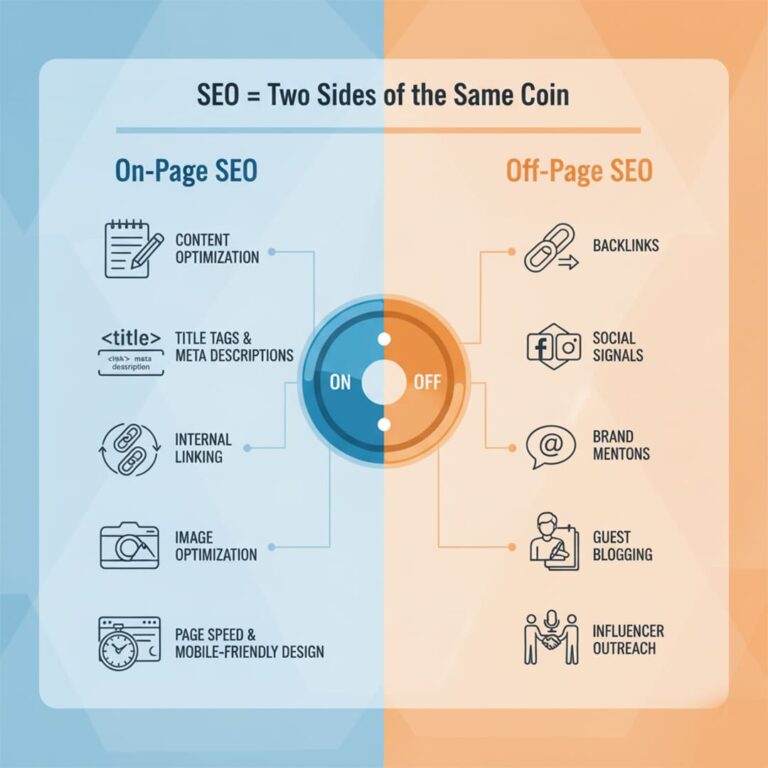
Think of SEO like running a physical store in a busy town. The two types of SEO represent different aspects of making your business successful. On-page SEO is like decorating your shop interior, organizing products, creating clear signage, and ensuring customers can easily find what they’re looking for once they step inside. Off-page SEO, on the other hand, is like building your reputation in the community, getting recommendations from other business owners, earning mentions in the local newspaper, and having satisfied customers tell their friends about your store.
This division exists because search engines like Google need to evaluate websites from multiple angles. They want to know: “Is this website well-organized and helpful?” (on-page factors) and “Do other reputable websites trust and recommend this site?” (off-page factors). Neither approach alone can guarantee success, they’re two sides of the same coin.
The beauty of understanding these two types of SEO lies in their complementary nature. A perfectly optimized website with poor external reputation will struggle to rank, just as a site with amazing backlinks but terrible user experience will eventually lose its rankings. Google’s algorithm has evolved to demand excellence in both areas, making it essential for modern businesses to master both approaches.
Type 1: On-Page SEO
On-page SEO encompasses everything you can directly control on your website to improve its search engine visibility. It’s the foundation of your digital presence, the solid ground upon which all other SEO efforts are built. This type of SEO focuses on optimizing individual web pages to rank higher and earn more relevant traffic from search engines.
The core elements of on-page SEO include strategic keyword placement, compelling meta descriptions, optimized title tags, header structure, internal linking, content quality, page loading speed, mobile responsiveness, and user experience signals. Each element plays a crucial role in helping search engines understand your content and determining how valuable it is to users.
Let me share Marco’s story to illustrate this perfectly. Marco owned a small café called “Espresso Romano” in the heart of Rome. His website looked beautiful, but it wasn’t attracting local customers searching for “best espresso Rome” or “authentic Italian café near Colosseum.” We started with basic on-page optimization: rewrote his title tags to include location-based keywords, optimized his meta descriptions to highlight his unique selling points, and restructured his content using proper header tags (H1, H2, H3).
The transformation was remarkable. We improved his page loading speed from 4.2 seconds to 1.8 seconds, added schema markup for local business information, and created location-specific landing pages for different Roman neighborhoods. Marco’s café started appearing in the top three results for local coffee searches within two months.
Content optimization forms the heart of on-page SEO. This means creating valuable, comprehensive content that genuinely answers user questions while naturally incorporating target keywords. Internal linking helps distribute page authority throughout your site while guiding users to related content. Technical aspects like SSL certificates, clean URL structures, and proper image optimization ensure search engines can easily crawl and index your pages.
The key to successful on-page SEO lies in balancing optimization for search engines with creating genuine value for human visitors. When done correctly, on-page SEO creates a seamless user experience that search engines reward with higher rankings.
Type 2: Off-Page SEO
Off-page SEO represents all optimization activities that happen outside your website but directly impact your search engine rankings. While you can’t control these factors as directly as on-page elements, you can influence them through strategic outreach, relationship building, and reputation management. This type of SEO essentially measures how much the internet trusts and values your website.
The primary components of off-page SEO include backlink acquisition, social media signals, brand mentions, online reviews, influencer collaborations, press coverage, and local citations. Among these, backlinks, links from other websites pointing to yours, remain the most influential ranking factor. However, not all backlinks are created equal; search engines evaluate the authority, relevance, and trustworthiness of linking domains.
Aisha’s success story perfectly demonstrates off-page SEO’s power. She launched “Desert Rose Boutique,” an online fashion store in Dubai, with stunning product photography and well-optimized pages. Despite excellent on-page SEO, her rankings remained stagnant for months. The missing piece? Off-page authority.
We developed a comprehensive off-page strategy for Aisha’s boutique. First, we identified relevant fashion bloggers and influencers in the Middle East region. Through genuine relationship building, we secured feature articles about her sustainable fashion approach in three prominent lifestyle magazines. We also collaborated with local fashion events, earning natural backlinks from event websites and social media coverage.
The breakthrough came when a respected fashion journalist wrote about Aisha’s innovative eco-friendly packaging, resulting in backlinks from major sustainability websites. Research shows that top pages in Google have approximately 3.8 times more backlinks than lower-ranked ones, which perfectly explains Aisha’s ranking improvement. Within four months, her website’s domain authority increased from 12 to 28, and her organic traffic grew by 150%. More importantly, she started ranking on the first page for competitive keywords like “sustainable fashion Dubai” and “eco-friendly clothing UAE.”
Social signals, while not direct ranking factors, contribute to off-page SEO by increasing brand visibility and driving traffic that can lead to natural link building. Brand mentions, even without links, help search engines understand your business’s reputation and relevance in your industry.
The key to effective off-page SEO lies in focusing on quality over quantity. One high-authority backlink from a respected industry website carries more weight than dozens of low-quality directory links. Building genuine relationships within your industry and consistently providing value to your audience creates sustainable off-page SEO results.
On-Page SEO vs. Off-Page SEO: Key Differences
|
Aspect |
On-Page SEO |
Off-Page SEO |
|
Control Level |
Complete control |
Indirect influence |
|
Time to Results |
2-4 months |
4-12 months |
|
Cost |
Lower (mostly time investment) |
Higher (outreach, tools, PR) |
|
Primary Focus |
Content and technical optimization |
Authority and reputation building |
|
Main Elements |
Keywords, meta tags, site speed, UX |
Backlinks, social signals, brand mentions |
|
Measurability |
Easy to track and adjust |
Harder to measure direct impact |
|
Longevity |
Immediate impact, requires maintenance |
Longer-lasting effects |
|
Risk Level |
Low risk when following guidelines |
Higher risk if using black-hat tactics |
Understanding these differences helps you allocate resources effectively and set realistic expectations for your SEO campaigns. On-page SEO provides the foundation and quicker wins, while off-page SEO builds long-term authority and competitive advantage.
How On-Page and Off-Page SEO Work Together
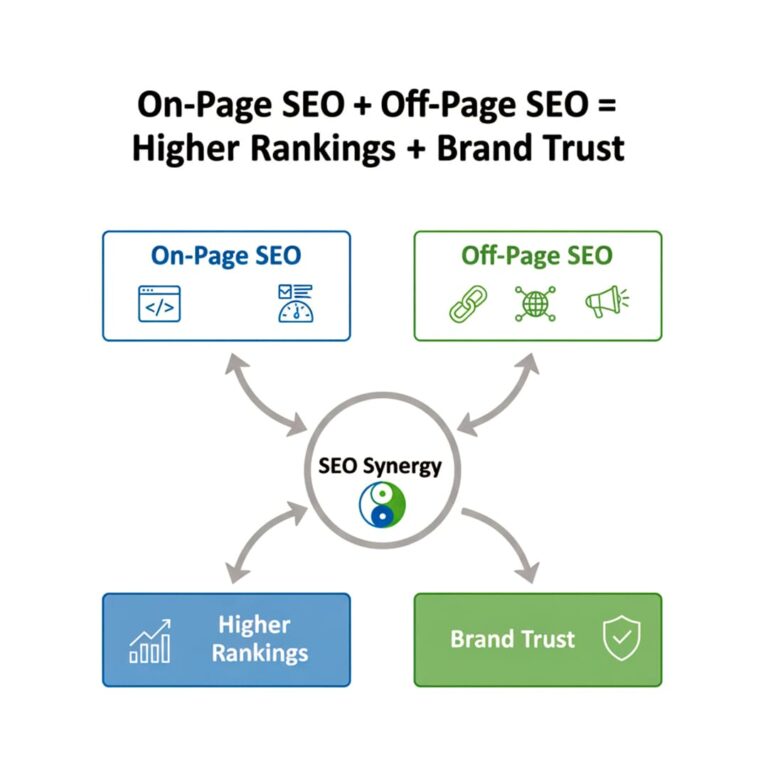
The magic of SEO happens when both types work in harmony, creating a synergistic effect that’s greater than the sum of its parts. Think of on-page SEO as preparing an excellent meal and off-page SEO as getting people to come to your restaurant, modern Google ranking factors show that user experience signals, authoritative backlinks, and high-quality content work together. You need both elements for sustainable success.
When your on-page SEO is solid, it makes your off-page efforts more effective. High-quality content naturally attracts backlinks, social shares, and brand mentions. Conversely, strong off-page signals give search engines confidence in your content, helping your well-optimized pages rank higher than they would based on on-page factors alone.
Let me tell you about Emma, a digital marketing coach in Copenhagen who experienced this synergy firsthand. Despite having years of expertise, her website struggled to attract new clients. Her blog posts were well-written but technically poor (slow loading, no schema markup, weak internal linking). Meanwhile, she had virtually no backlinks or industry recognition online.
We started by fixing her on-page foundation: optimized her site architecture, improved page speed from 3.8 to 1.2 seconds, and restructured her content with proper keyword targeting. Simultaneously, we launched an off-page campaign where Emma started guest posting on marketing blogs, speaking at virtual conferences, and building relationships with other coaches.
The results were extraordinary. Her improved on-page SEO made her guest posts more valuable to host websites, leading to better placement and more traffic. The increased visibility from off-page activities drove more engagement with her optimized content. Within eight months, Emma’s organic leads tripled, and she became a recognized voice in the digital marketing space.
This synergy explains why the most successful SEO strategies never focus on just one type. Search engines want to see signals from both areas before granting top rankings for competitive keywords.
How On-Page and Off-Page SEO Work Together
Mastering the two types of SEO requires following proven best practices that align with search engine guidelines and user expectations. For on-page SEO, focus on creating comprehensive, user-focused content that thoroughly covers topics relevant to your audience. Conduct thorough keyword research, but integrate terms naturally rather than forcing them into every paragraph.
Technical excellence forms the backbone of on-page success. Ensure your website loads quickly across all devices, implement proper header structure (H1, H2, H3), optimize images with descriptive alt text, and create XML sitemaps to help search engines understand your site structure. Regular technical audits help identify and fix issues like broken links, duplicate content, and crawl errors.
For off-page SEO, prioritize building relationships over collecting links. Focus on earning backlinks from relevant, high-authority websites in your industry. This often means creating link-worthy content like original research, comprehensive guides, or tools that other websites want to reference. Guest posting remains effective when you provide genuine value to the host website’s audience rather than just seeking link placement.
Many successful SEO agencies use detailed checklists to ensure consistency across both types. For on-page optimization, they verify title tag optimization, meta description compelling-ness, content depth and quality, internal linking strategy, and technical performance. For off-page efforts, they track backlink quality, brand mention sentiment, social media engagement, and competitive gap analysis.
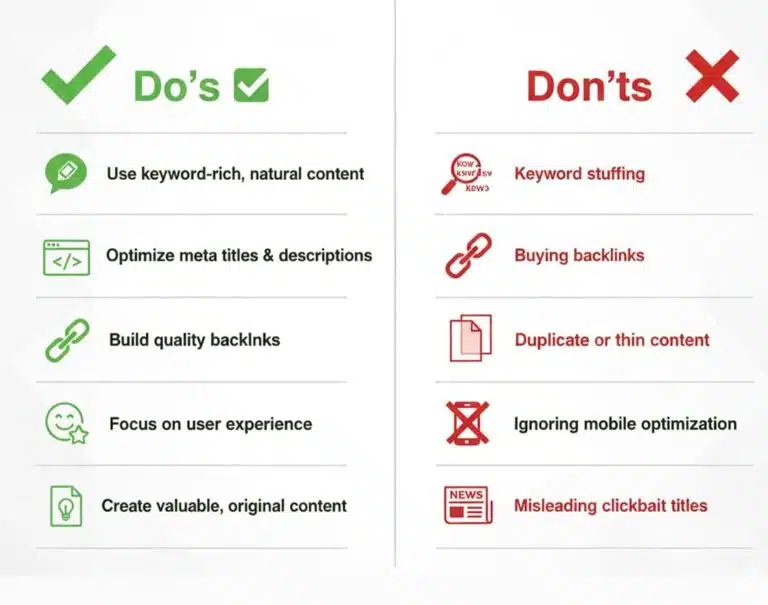
The most sustainable approach involves white-hat techniques that focus on long-term value creation. This means avoiding shortcuts like keyword stuffing, buying low-quality backlinks, or participating in link schemes that could result in search engine penalties.
Common Mistakes to Avoid
Even experienced marketers sometimes fall into traps that can harm their SEO performance. Understanding these common mistakes helps you avoid setbacks and build more effective strategies around both types of SEO.
In on-page SEO, keyword stuffing remains a persistent problem. Many website owners believe that cramming their target keyword into every sentence will improve rankings, but this approach often backfires by creating unreadable content that both users and search engines dislike. Instead, focus on semantic keyword variation and natural language patterns.
Duplicate content represents another significant on-page mistake. This includes having multiple pages targeting the same keyword, copying content from other websites, or creating thin pages with minimal unique value. Search engines struggle to determine which version deserves to rank, often resulting in none of your pages achieving top positions.
Technical neglect can undermine even the best content. Common issues include slow page loading speeds, poor mobile optimization, missing SSL certificates, and broken internal links. These problems signal to search engines that your website doesn’t provide a good user experience.
Off-page SEO mistakes often involve taking shortcuts that can severely damage your website’s reputation. Buying cheap backlinks from link farms, participating in excessive reciprocal link exchanges, or using automated link building tools can result in manual penalties that are difficult to recover from.
Another critical off-page mistake is neglecting brand reputation management. Negative reviews, poor social media presence, or lack of brand mentions can signal to search engines that your business lacks authority in its industry. Monitor your online reputation actively and address issues promptly.
The key insight here is that both types of SEO require patience and ethical approaches. Quick fixes rarely work in modern SEO, and attempts to game the system often result in worse performance than taking no action at all.
Case Study: Using Both Types Together
Let me share Lena’s remarkable transformation story, which perfectly demonstrates how the two types of SEO work together to create extraordinary results. Lena launched “Nordic Home,” an e-commerce store specializing in Scandinavian furniture and home décor from her base in Berlin. Despite her beautiful products and competitive prices, her online sales remained disappointing for the first year.
When we analyzed her situation, the problems were clear. Her product pages had minimal content, no customer reviews were displayed, page loading times exceeded 4 seconds, and she had virtually no backlinks or brand recognition. Her website ranked on page 4-6 for relevant keywords, making it nearly invisible to potential customers.
We implemented a comprehensive strategy addressing both types of SEO simultaneously. For on-page optimization, we rewrote all product descriptions to include detailed specifications, care instructions, and styling suggestions. We optimized over 200 product pages with relevant keywords like “Scandinavian furniture Berlin,” “Nordic home décor,” and “minimalist furniture Germany.”
Technical improvements included compressing images to improve page speed, implementing schema markup for products, and creating a logical site structure with clear category hierarchies. This was crucial since 53% of mobile users abandon sites that take longer than 3 seconds to load, according to Google research. We also launched a blog featuring interior design tips, seasonal décor ideas, and behind-the-scenes content about Nordic design philosophy.
For off-page SEO, we identified interior design bloggers, home décor influencers, and lifestyle publications in German-speaking countries. Lena started providing expert quotes for articles about minimalist living and Scandinavian design trends. We secured features in three major home décor magazines and collaborated with interior designers who featured her products in their projects.
The results exceeded our expectations. Within six months, Lena’s organic traffic increased by 180%, her average session duration improved from 1.2 minutes to 3.7 minutes, and most importantly, her online sales grew by 70%. She now ranks in the top three positions for most of her target keywords and has established Nordic Home as a trusted brand in the German furniture market.
This case study illustrates how on-page and off-page SEO amplify each other’s effectiveness. The improved on-page experience made visitors more likely to engage with Lena’s content and products, while increased brand authority from off-page efforts helped her pages rank higher for competitive terms.
Conclusion
Understanding and implementing the two types of SEO isn’t just about improving search rankings, it’s about building a sustainable online presence that attracts, engages, and converts your ideal customers. On-page SEO creates the foundation by ensuring your website is fast, user-friendly, and filled with valuable content. Off-page SEO builds the authority and trust that search engines need to recommend your site to their users.
The businesses that thrive in today’s competitive digital landscape are those that master both approaches. They create exceptional on-site experiences while simultaneously building their reputation and authority across the broader internet. This balanced approach not only improves search rankings but also enhances brand credibility and customer trust.
Remember Sofia’s bookstore in Lisbon, Marco’s café in Rome, Aisha’s boutique in Dubai, Emma’s coaching practice in Copenhagen, and Lena’s furniture store in Berlin. Each found success by embracing both types of SEO as complementary strategies rather than competing priorities.
Your next step is clear: audit your current SEO efforts to identify gaps in either on-page or off-page optimization. Start with the basics in whichever area needs more attention, but always keep the bigger picture in mind. The two types of SEO work best when they work together, creating a powerful synergy that can transform your online presence and drive sustainable business growth.
The digital landscape will continue evolving, but the fundamental principle remains constant: search engines reward websites that provide excellent user experiences and earn trust from the broader internet community. Master both types of SEO, and you’ll be well-positioned for long-term success in the ever-changing world of search engine optimization.
FAQs on Two Types of SEO
Both are essential, but priority depends on your current situation. Focus on on-page SEO first if you have technical issues. For established sites with good optimization, off-page SEO becomes crucial for competitive rankings. Content and links remain among the three most important Google ranking signals in 2025.
On-page SEO shows results in 2-4 months, while off-page SEO takes 4-12 months. Over 99% of searchers never click past the first page, making patience essential for both strategies.
Yes. Even basic off-page activities like customer reviews and local listings make a significant difference. The key is scaling efforts according to resources while maintaining focus on both areas.
SEO algorithms change daily, with major impactful updates occurring a few times each year.
Focus on high-quality content, strong user experience, and technical best practices to stay resilient against future updates.