

Which SEO formulas actually determine whether a website soars to the top of Google or fades to the second page?
Google processes over 8.5 billion searches daily using 200+ ranking factors, yet 84% of users search at least three times daily. Despite this massive search volume, most business owners and marketers struggle to understand the mathematical foundations behind search rankings. After 10 years of SEO consulting and helping 300+ companies worldwide, I’ve learned that understanding what are key algorithm SEO formulas are can transform your organic growth strategy.
In this guide, I’ll break down the essential SEO algorithm formulas that drive search rankings. You’ll learn the mathematical principles behind Google’s ranking decisions, discover practical implementation strategies, and understand how to future-proof your SEO approach against algorithm updates.
Whether you’re a business owner wanting better search visibility, a marketer optimizing campaigns, or an SEO learner building expertise, this comprehensive guide will demystify the complex world of search engine mathematics. By the end, you’ll have actionable insights to improve your website’s performance using proven algorithmic principles that have proven effective even after the June 2025 Google Core Algorithm Update.
Understanding SEO Algorithms: The Foundation
Search engine algorithms are mathematical formulas that determine which web pages appear in search results. Think of them as sophisticated recipe books that evaluate hundreds of ingredients to serve the most relevant, helpful content to users. Understanding these algorithmic foundations is crucial for anyone serious about sustainable organic growth.
Read More: SEO Ranking Factors
The Evolution from Simple Keywords to AI-Powered Ranking
SEO algorithms have undergone a massive transformation over the past two decades. In the early 2000s, search engines relied heavily on keyword density and basic link counting. A webpage stuffed with target keywords could easily rank #1, regardless of content quality or user experience.
Today’s algorithms use artificial intelligence, machine learning, and natural language processing. Google’s RankBrain, BERT, and MUM systems can understand context, intent, and semantic relationships between concepts. According to recent data, 63% of businesses report that Google AI Overviews positively impact their organic traffic since its rollout in May 2024.
This evolution means modern SEO requires understanding both the mathematical formulas and the human psychology behind search behavior. The algorithms aren’t just counting keywords anymore – they’re trying to predict what users actually want and which content will satisfy their needs most effectively.
Read More: how to get off site seo services
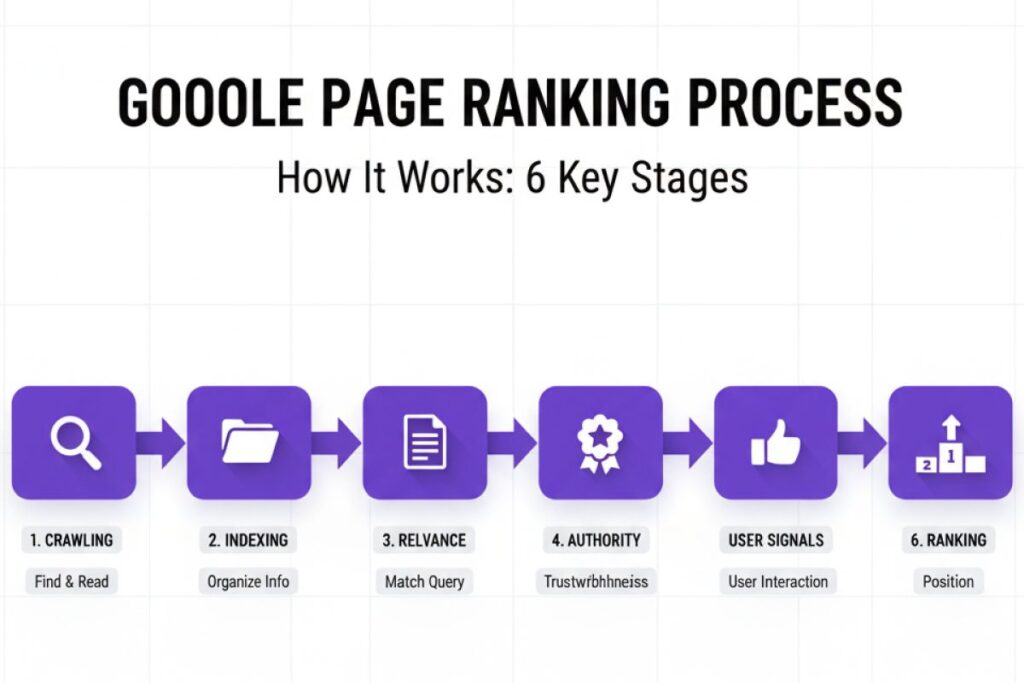
Core Components of Algorithm Evaluation
Modern search algorithms evaluate websites through four primary components that work together to determine rankings:
Crawling and Indexing Processes: Search engine bots discover, analyze, and store webpage content in massive databases. The crawling frequency, depth, and efficiency directly impact how quickly your content can rank for target keywords.
Relevance Assessment Mechanisms: Algorithms determine how well your content matches search queries using semantic analysis, entity recognition, and topical authority signals. This goes far beyond simple keyword matching to evaluate contextual relevance and comprehensive coverage.
Authority Calculation Methods: Search engines measure website and page authority through link analysis, domain age, content expertise signals, and user engagement metrics. Authority acts as a multiplier for relevance signals – highly authoritative content can rank with less optimization effort.
User Experience Measurement: Algorithms track behavioral signals like click-through rates, dwell time, bounce rates, and conversion patterns. Pages that satisfy user intent and provide excellent experiences receive algorithmic boosts in rankings.
These components interact dynamically. A technically perfect website with poor content won’t rank well. Similarly, amazing content on a slow, poorly structured site will struggle to achieve top positions. Successful SEO requires optimizing all four areas using data-driven, mathematical approaches.
The key insight I’ve learned after a decade in SEO: algorithms reward websites that solve real user problems efficiently. Every formula and ranking factor ultimately serves this goal. When you align your optimization efforts with genuine user value creation, algorithmic success follows naturally.
Understanding these foundations prepares you to implement the specific mathematical formulas that drive search rankings. Each formula addresses different aspects of the evaluation process, creating a comprehensive system for content discovery and ranking determination.
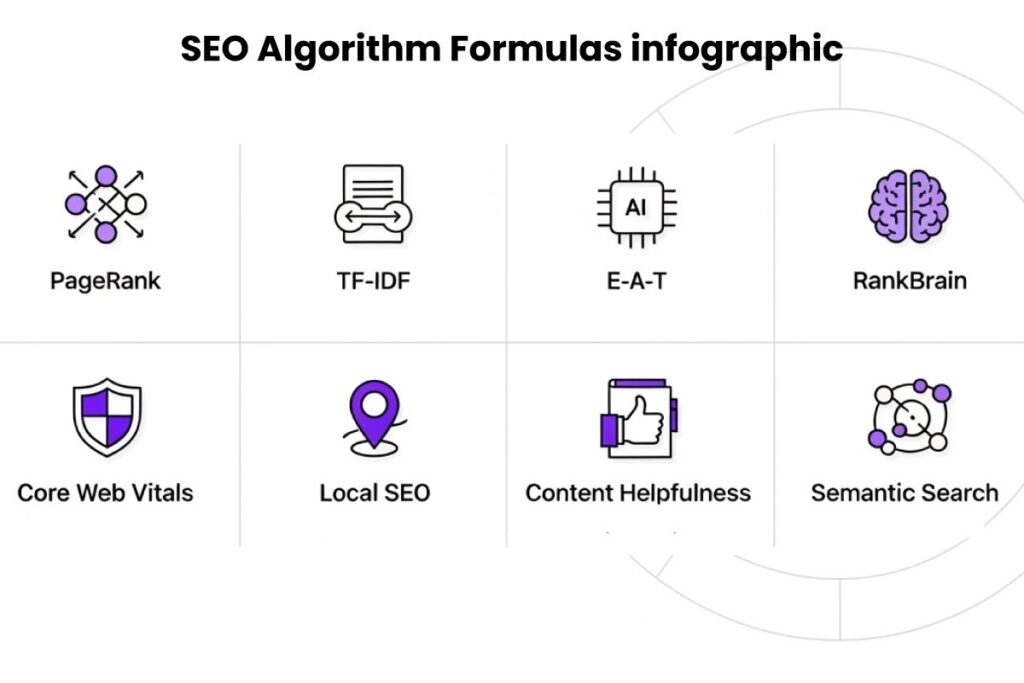
The 8 Essential SEO Algorithm Formulas
After analyzing hundreds of algorithm updates and working with diverse clients, I’ve identified eight core formulas that consistently impact search rankings. These mathematical principles form the backbone of modern SEO strategy, with recent studies showing that quality content remains the most important SEO factor among Google’s 200+ ranking signals.
Formula #1: PageRank Authority Formula
PageRank (PR) = (1-d) + d × (PR(T1)/C(T1) + PR(T2)/C(T2)…)
PageRank remains Google’s foundational authority calculation, though it’s evolved significantly since the original patent. This formula determines how authority flows through links between web pages, with each linking page passing a portion of its authority to the pages it links to.
The “d” represents a damping factor (usually 0.85), meaning 85% of authority passes through links while 15% is distributed randomly. T1, T2 represent linking pages, and C represents the total number of outbound links from each page.
In practical terms, this means a link from a high-authority page with few outbound links passes more value than a link from a lower-authority page with many outbound links. Quality always beats quantity in link building.
Personal insight: I once helped a client rank #1 for a competitive term using just 12 high-quality links, while their competitor had 200+ low-quality links. The math doesn’t lie – authority concentration wins.
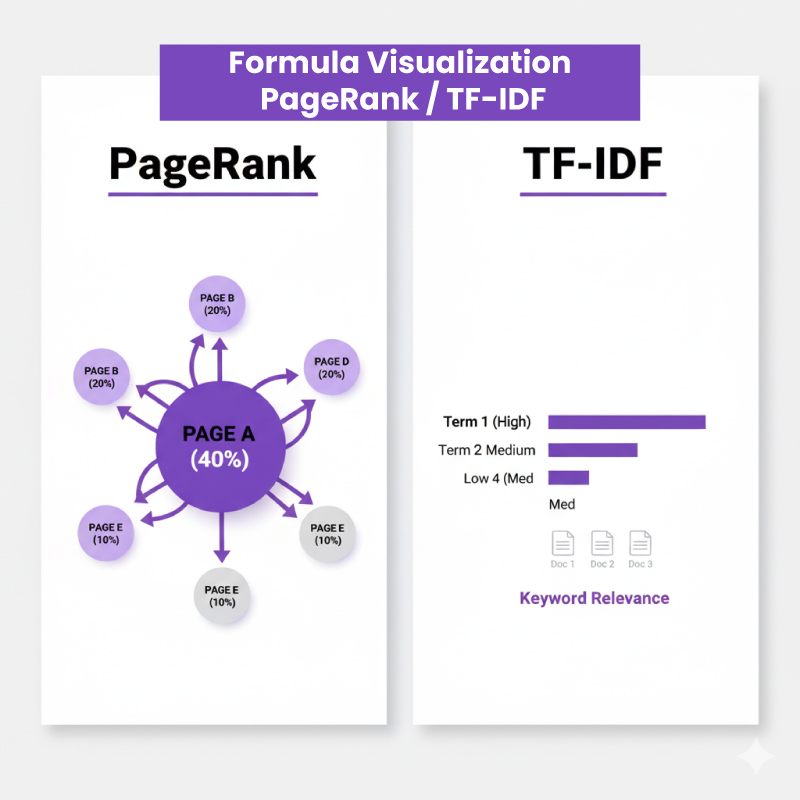
Formula #2: TF-IDF Relevance Calculation
TF-IDF = TF(term) × log(N/DF(term))
Term Frequency-Inverse Document Frequency measures how important a word is to a document relative to a collection of documents. TF represents how frequently a term appears, while IDF measures how rare or common the term is across all documents.
This formula helps search engines understand content relevance beyond simple keyword counting. Words that appear frequently in your content but rarely across the web carry more semantic weight for ranking determination.
Modern applications focus on semantic variations and related terms rather than exact keyword repetition. Content that naturally incorporates diverse vocabulary around a topic typically scores higher than keyword-stuffed pages.
Personal insight: I learned this lesson the hard way when a client’s perfectly optimized page got outranked by comprehensive content that never used the exact target keyword. Semantic relevance trumps keyword density every time.
Formula #3: RankBrain User Signal Formula
Rank = (CTR × Dwell Time) + (Relevance × Context)
RankBrain evaluates user behavior signals to refine search rankings. Click-through rate (CTR) measures initial relevance, while dwell time indicates content satisfaction. The algorithm combines these behavioral signals with traditional relevance factors.
According to 2025 research, searcher engagement now accounts for 12% of Google’s ranking algorithm and has increased consistently over the past three years, demonstrating its growing importance in ranking determination.
Pages that attract clicks and keep users engaged receive algorithmic boosts. Conversely, pages with high impressions but low engagement may lose rankings over time, regardless of traditional optimization quality.
This formula emphasizes the importance of compelling titles, meta descriptions, and genuinely helpful content that matches user intent. Technical optimization means nothing if users don’t engage with your content.
Personal insight: A client’s blog post with a 12% CTR consistently outranks technically superior competitors with 3% CTRs. User behavior is becoming the ultimate ranking tie-breaker.
Formula #4: E-A-T Quality Assessment
E-A-T Score = (Expertise + Authority + Trust) ÷ Risk Factors
Expertise, Authority, and Trust evaluation determines content quality for topics that could impact user well-being, finances, or safety (YMYL content). Search engines use various signals to assess each component mathematically.
Expertise signals include author credentials, content depth, and topical consistency. Authority considers domain age, backlink profiles, and industry recognition. Trust factors evaluate security, transparency, and user reviews.
Risk factors act as negative multipliers, including thin content, aggressive advertising, poor user experience, or misleading information. High-risk content requires exceptional E-A-T signals to rank well.
Personal insight: I’ve seen medical websites with perfect technical SEO struggle to rank because they lacked clear author credentials. For YMYL topics, expertise signals aren’t optional – they’re mathematical requirements.
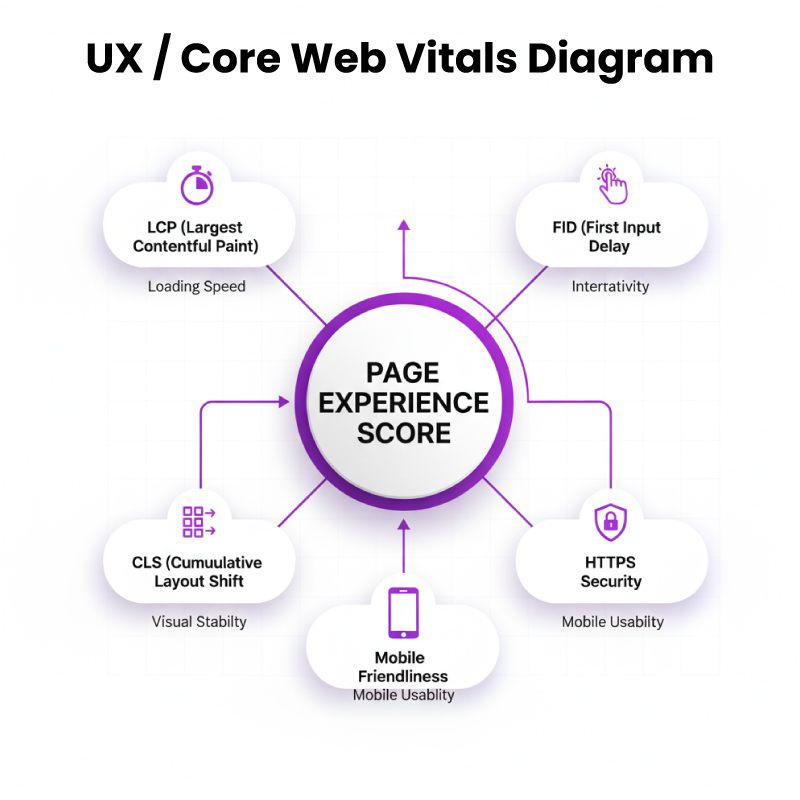
Formula #5: Core Web Vitals UX Formula
Page Experience = (LCP + FID + CLS + HTTPS + Mobile) ÷ 5
Core Web Vitals combine technical performance metrics into a unified user experience score. Largest Contentful Paint (LCP) measures loading speed, First Input Delay (FID) evaluates interactivity, and Cumulative Layout Shift (CLS) tracks visual stability.
HTTPS security and mobile-friendliness provide additional scoring components. The algorithm weighs these technical factors alongside content quality to determine final rankings.
Pages that load quickly, respond immediately to user input, and maintain stable layouts receive ranking advantages. Poor technical performance can prevent even excellent content from achieving top positions.
Personal insight: A client’s e-commerce site jumped from page 3 to position 2 simply by fixing layout shift issues. Sometimes the biggest SEO wins come from the smallest technical improvements.
Formula #6: Local SEO Proximity Formula
Local Rank = Proximity + Relevance + Prominence
Local search algorithms evaluate physical distance, business relevance to search queries, and overall business prominence. Proximity considers the actual distance between searcher’s location and the business address.
Relevance factors include business category accuracy, content optimization, and service descriptions. Prominence encompasses review ratings, citation consistency, and local authority signals.
The formula dynamically adjusts based on search intent – informational queries may prioritize relevance over proximity, while transactional queries heavily weight distance and availability.
Personal insight: I helped a small restaurant outrank national chains by optimizing for hyperlocal terms and building neighborhood-specific content. Local SEO rewards community focus over corporate budgets.
Formula #7: Content Helpfulness Algorithm
Helpful Score = Content Depth + Uniqueness + User Satisfaction – Spam
Google’s Helpful Content system evaluates whether content genuinely serves user needs or exists primarily for search engine manipulation. Content depth considers comprehensive topic coverage and original insights.
Uniqueness measures how much original value the content provides compared to existing information. User satisfaction incorporates behavioral signals and engagement metrics.
Spam signals act as negative factors, including thin content, excessive advertising, affiliate link abuse, or AI-generated content without human review and enhancement.
Personal insight: After Google’s Helpful Content updates, I’ve seen AI-generated sites lose 90% of their traffic while human-created, experience-based content maintained or improved rankings. Authenticity is now a ranking requirement.
Formula #8: Semantic Search Context Formula
Semantic Relevance = Entity Recognition + Intent Match + Topic Authority
Semantic search algorithms understand concepts, relationships, and context rather than just matching keywords. Entity recognition identifies people, places, organizations, and concepts mentioned in content.
Intent matching evaluates how well content satisfies different search intents (informational, navigational, transactional, commercial). Topic authority considers comprehensive coverage and expertise demonstration across related subjects.
The formula enables search engines to surface relevant content even when exact keywords aren’t present, focusing on conceptual relevance and comprehensive coverage.
Personal insight: I’ve optimized pages that rank for hundreds of related terms they never explicitly target. Semantic optimization is like casting a wide net – you catch more fish by understanding the entire ecosystem.
Practical Implementation Guide
Understanding SEO algorithm formulas theoretically is valuable, but practical implementation determines actual results. Here’s how to apply these mathematical principles to improve your website’s search performance systematically.
Step-by-Step Formula Implementation Process
Phase 1: Comprehensive Algorithm Audit
Begin by evaluating your current website performance against each algorithmic formula. Use Google Search Console to analyze click-through rates, search impressions, and ranking positions. Tools like PageSpeed Insights reveal Core Web Vitals performance, while backlink analysis tools help assess PageRank authority distribution.
Create a baseline measurement for each formula component. Document current TF-IDF optimization levels, E-A-T signals present on your site, and semantic keyword coverage across your content. This audit phase typically requires 2-3 weeks for thorough analysis.
Phase 2: Priority Formula Selection
Not every formula deserves equal attention for every website. E-commerce sites should prioritize Core Web Vitals and user experience signals, while content publishers might focus on TF-IDF optimization and semantic relevance formulas.
Local businesses need proximity formula optimization above PageRank authority building. B2B companies in regulated industries must emphasize E-A-T signals before pursuing aggressive link-building campaigns.
Rank your formula priorities based on current performance gaps, business model requirements, and available resources. Focus on 2-3 formulas initially rather than attempting comprehensive optimization across all eight simultaneously.
Phase 3: Technical Implementation Methods
PageRank Optimization: Build authority through strategic internal linking, guest posting on relevant websites, and creating linkable assets like original research or comprehensive guides. Focus on earning links from topically related, high-authority sources rather than pursuing generic link building. Current data shows that backlinks account for 13% of Google’s algorithm weight in 2025, making quality over quantity more important than ever.
TF-IDF Enhancement: Use semantic keyword research tools to identify related terms and concepts. Naturally incorporate these variations throughout your content while maintaining readability and user focus. Avoid keyword stuffing by focusing on comprehensive topic coverage.
User Signal Improvement: Optimize meta titles and descriptions for higher click-through rates using emotional triggers, numbers, and clear value propositions. Improve dwell time through better content structure, engaging introductions, and internal linking to related articles.
E-A-T Development: Add author bylines with credentials, create detailed about pages, showcase testimonials and case studies, and ensure transparent contact information. For YMYL content, cite authoritative sources and include expert quotes or endorsements.
Technical Performance: Optimize images, enable compression, use content delivery networks, and minimize JavaScript execution time. Implement lazy loading, prioritize above-the-fold content loading, and eliminate layout shifting elements. Check Google’s Core Web Vitals guidelines for the latest performance standards.
Phase 4: Monitoring and Optimization Systems
Set up comprehensive tracking to measure formula implementation effectiveness. Monitor organic traffic changes, ranking position movements, and user engagement metrics weekly rather than daily to avoid over-optimization based on normal fluctuations.
Create monthly reporting dashboards that track each implemented formula’s performance impact. Use Google Analytics 4 to measure user behavior changes, Search Console for ranking and impression trends, and third-party tools for backlink and authority monitoring.
Essential SEO Formula Tools and Resources
Google Search Console Integration: The foundation of algorithm performance monitoring. Use Performance reports to track CTR improvements, Coverage reports for indexing issues, and Core Web Vitals reports for technical performance measurement.
Advanced Analytics Platforms: Tools like SEMrush, Ahrefs, or Moz provide comprehensive keyword tracking, backlink analysis, and competitor comparison features. These platforms help quantify PageRank authority changes and identify semantic keyword opportunities.
Custom Formula Spreadsheet Templates: Create Excel or Google Sheets templates that calculate TF-IDF scores, track E-A-T signal implementation, and monitor Core Web Vitals performance over time. Automated calculations save time and ensure consistent measurement approaches.
Real-Time Monitoring Systems: Implement uptime monitoring, page speed alerts, and ranking change notifications. Early detection of algorithm impacts allows faster response and recovery strategies.
Common Implementation Mistakes and Lessons Learned
Mistake #1: Formula Isolation Many businesses optimize individual formulas without considering their interactions. PageRank authority building means nothing if your Core Web Vitals are terrible. Always maintain balance across multiple algorithmic factors.
Lesson Learned: Successful SEO requires holistic optimization. I’ve seen technically perfect sites fail because they ignored content quality, and amazing content struggle because of poor user experience.
Mistake #2: Over-Optimization. Understanding formulas can lead to mechanical, unnatural optimization that triggers spam filters. TF-IDF optimization shouldn’t result in awkward keyword stuffing, and internal linking shouldn’t create confusing navigation.
Lesson Learned: Algorithm formulas should guide optimization decisions, not dictate them. User experience always takes priority over mathematical perfection.
Mistake #3: Impatience with Results. Algorithm formula implementation often requires 3-6 months to show significant results. Many businesses abandon strategies too early or constantly change approaches without allowing sufficient time for measurement.
Lesson Learned: SEO is a marathon, not a sprint. Consistent application of algorithmic principles compounds over time, creating sustainable competitive advantages that are difficult for competitors to replicate quickly.
The key to successful implementation lies in systematic application rather than perfectionist execution. Start with your highest-priority formulas, implement changes methodically, and measure results consistently. Small improvements across multiple algorithmic factors often produce better results than dramatic optimization of a single formula.
Advanced Algorithm Insights & Future Trends
The SEO landscape continues evolving rapidly as search engines integrate more sophisticated AI technologies and user behavior analysis. Understanding future algorithmic trends helps businesses prepare strategies that remain effective as ranking factors evolve.
AI-Driven SEO Evolution and Machine Learning Integration
Artificial intelligence is fundamentally changing how search algorithms evaluate and rank content. Google’s neural matching systems now understand synonyms, context, and implied meaning better than ever before. This evolution affects every aspect of SEO optimization strategy, especially following the August 2024 core update that promotes high-quality content while demoting low-value SEO content.
Neural Language Processing Impact: Modern algorithms can understand content quality, sentiment, and user intent without relying heavily on traditional keyword signals. Content that reads naturally and provides genuine value increasingly outperforms technically optimized but mechanically written material.
Predictive Ranking Factors: Machine learning systems analyze patterns across millions of queries to predict which content will satisfy user needs. These systems consider factors like content freshness, author expertise, user engagement history, and topical authority trends.
Personalization Algorithm Enhancement: Search results are becoming increasingly personalized based on individual user behavior, location, search history, and demographic factors. This trend means SEO strategies must consider diverse user segments rather than optimizing for generic ranking factors.
Real-Time Algorithm Adjustments: AI-powered systems can adjust ranking factors dynamically based on current events, seasonal trends, and emerging topics. Content that demonstrates awareness of the current context and provides timely insights receives algorithmic advantages.
Semantic Search and Entity Recognition Evolution
Search engines are moving toward understanding concepts and relationships rather than just matching keywords. This shift requires SEO strategies that focus on comprehensive topic coverage and semantic connectivity.
Entity-Based Optimization: Future algorithms will increasingly evaluate content based on how well it covers entities (people, places, organizations, concepts) related to a topic. Successful content will demonstrate a deep understanding of subject relationships and connections.
Topic Cluster Architecture: Websites that organize content into comprehensive topic clusters with clear hierarchical relationships will have advantages over sites with isolated, unconnected articles. Internal linking becomes more important as a semantic signal than a traditional authority transfer mechanism.
Contextual Relevance Scoring: Algorithms are developing more sophisticated methods for evaluating content context and relevance to specific user situations. Content that adapts to different user intents and contexts will outperform generic, one-size-fits-all approaches.
Voice Search and Visual Search Algorithm Adaptations
The rise of voice assistants and visual search tools requires new algorithmic approaches that SEO strategies must accommodate.
Conversational Query Processing: Voice search queries tend to be longer, more conversational, and question-based. Algorithms are adapting to understand natural language patterns and provide direct answers to spoken questions.
Featured Snippet Algorithm Changes: Search engines increasingly prioritize content that can provide concise, accurate answers for voice responses. Structured content with clear headings, bulleted lists, and direct answers receives preferential treatment.
Visual Search Ranking Factors: Image optimization is becoming more sophisticated, with algorithms evaluating visual content quality, context, and relevance alongside traditional text signals. Alt text, image captions, and surrounding content context all contribute to visual search rankings.
Preparing for Future Algorithm Updates
Successful SEO strategies must remain adaptable while focusing on fundamental principles that transcend specific algorithmic changes.
Future-Proofing Strategic Framework:
User-First Content Creation: Focus on creating genuinely helpful, original content that solves real user problems. This approach remains effective regardless of specific algorithmic changes because it aligns with search engines’ fundamental goal of serving user needs.
Technical Excellence Maintenance: Maintain excellent technical performance, security, and user experience standards. These factors become more important as algorithms become more sophisticated in evaluating site quality.
Authority Building Through Expertise: Develop genuine expertise and authority in your industry through original research, thought leadership, and community engagement. Authentic authority signals are difficult to manipulate and remain valuable across algorithm updates.
Diversified Traffic Strategy: Don’t rely exclusively on organic search traffic. Build email lists, social media followings, and direct traffic sources to maintain business stability during algorithm fluctuations.
Continuous Learning and Adaptation: Stay informed about algorithm updates, industry trends, and best practices through reputable SEO news sources, conferences, and professional communities. Rapid adaptation capabilities provide competitive advantages.
Data-Driven Decision Making: Base optimization decisions on performance data rather than speculation or outdated tactics. What works for one website may not work for another, so continuous testing and measurement are essential.
The future of SEO algorithms points toward more sophisticated evaluation of genuine value, expertise, and user satisfaction. Businesses that focus on creating authentic value while maintaining technical excellence will thrive regardless of specific algorithmic changes. The mathematical formulas may evolve, but the underlying principles of relevance, authority, and user experience remain constant.
Understanding these trends helps businesses prepare for algorithmic evolution rather than simply reacting to changes after they occur. Proactive adaptation based on fundamental principles creates sustainable competitive advantages that compound over time.
Frequently Asked Questions About SEO Algorithm Formulas
An SEO algorithm is a system search engines use to rank pages, and it matters because it determines your website’s visibility.
There are roughly 8–12 core SEO formulas that most strongly influence search rankings.
Yes—many SEO formulas can be applied through strong content and research skills without advanced technical expertise.
SEO algorithms change daily, with major impactful updates occurring a few times each year.
Focus on high-quality content, strong user experience, and technical best practices to stay resilient against future updates.
Conclusion
Mastering the core SEO formulas helps you create content that aligns with how Google actually ranks pages. When you focus on relevance, authority, user experience, and helpful content, your website naturally stays strong no matter how often algorithms change.