
When Sophia Martinez, a graduate student at BrightPath Solutions, began her thesis journey, she spent countless hours sifting through unreliable sites before discovering the power of academic databases. Like many researchers today, she faced the overwhelming challenge of information overload, thousands of websites claiming to offer “academic resources,” but few delivering the credible, peer-reviewed content essential for quality research.
This problem isn’t unique. In my 8+ years as a CMS Web Designer and Developer, having delivered 700+ projects including numerous Learning Management Systems and educational platforms, I’ve witnessed firsthand how the right academic resources can transform research productivity. Working with educational institutions across the Gulf and USA, I’ve learned that choosing the best academic website depends entirely on your specific research needs, discipline, and access requirements.
This comprehensive guide will walk you through the top academic websites of 2025, evaluation criteria for reliable sources, and actionable strategies to optimize your research workflow. Whether you’re an undergraduate student, graduate researcher, or academic professional, you’ll discover the platforms that can elevate your scholarly work.
What Defines the "Best" Academic Website?
Before diving into specific platforms, understanding what separates exceptional academic websites from mediocre ones is crucial for making informed choices.
Content Quality & Credibility Factors
The foundation of any reliable academic website lies in its content standards. Top-tier platforms maintain rigorous peer-review processes, ensuring every published article undergoes scrutiny by subject matter experts. Look for websites backed by established institutions, universities, government agencies, or reputable publishers like Elsevier, Springer, or Oxford University Press.
Publisher reputation matters significantly. Websites associated with renowned academic publishers typically maintain higher editorial standards, employ professional fact-checkers, and implement strict quality control measures. These platforms also provide transparent information about their review processes, editorial boards, and publication criteria.
Accessibility & User Experience Standards
Modern academic websites must balance comprehensive content with user-friendly design. The best platforms offer mobile-responsive interfaces that function seamlessly across devices, considering that researchers increasingly access content via smartphones and tablets.
Loading speed directly impacts research efficiency. Premium academic websites invest in robust server infrastructure, ensuring rapid page loads even when accessing complex documents or large datasets. This technical reliability becomes critical during time-sensitive research periods.
The subscription versus free access model significantly affects accessibility. While subscription-based platforms often provide more comprehensive content, the rise of open-access initiatives has created excellent free alternatives without compromising quality.
Top Academic Search Engines
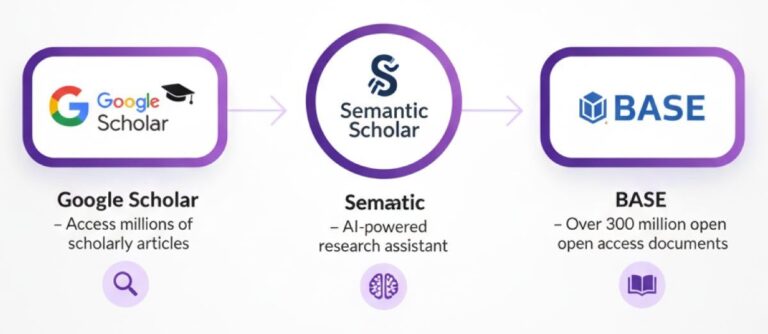
Academic search engines serve as the starting point for most research endeavors. These platforms aggregate content from multiple sources, providing comprehensive access to scholarly literature across disciplines.
Google Scholar - The Universal Research Gateway
Google Scholar dominates academic search with its latest metrics covering articles published between 2020-2024, with the h5-index calculated for articles published in 2020-2024 having at least h citations each. Its cross-disciplinary approach makes it invaluable for interdisciplinary research, while the familiar Google interface reduces learning curves for new users.
The platform’s citation tracking functionality allows researchers to gauge paper impact through “cited by” metrics. Integration with the broader Google ecosystem enables seamless saving to Google Drive and collaboration through Google Docs. The “My Library” feature helps organize research across projects.
However, Google Scholar’s inclusivity presents challenges. The platform’s automated indexing occasionally includes non-peer-reviewed content or predatory journals. Quality control relies heavily on user judgment rather than editorial oversight. Additionally, access to full-text documents depends on institutional subscriptions or open-access availability.
Semantic Scholar - AI-Powered Discovery
Developed by the Allen Institute for Artificial Intelligence, Semantic Scholar represents the next generation of academic search technology. The platform analyzes over 200 million papers using natural language processing, providing AI-generated summaries and highlighting key findings.
The standout feature is the TL;DR (Too Long; Didn’t Read) functionality, which provides concise paper summaries generated by machine learning algorithms. Citation influence metrics go beyond simple citation counts, analyzing the context and importance of references within citing papers.
BASE - Multilingual Search Engine
BASE (Bielefeld Academic Search Engine) aggregates over 136 million documents from carefully selected academic repositories worldwide. Unlike commercial platforms, BASE focuses exclusively on open-access content, making it invaluable for researchers without extensive institutional subscriptions.
Specialized Academic Databases
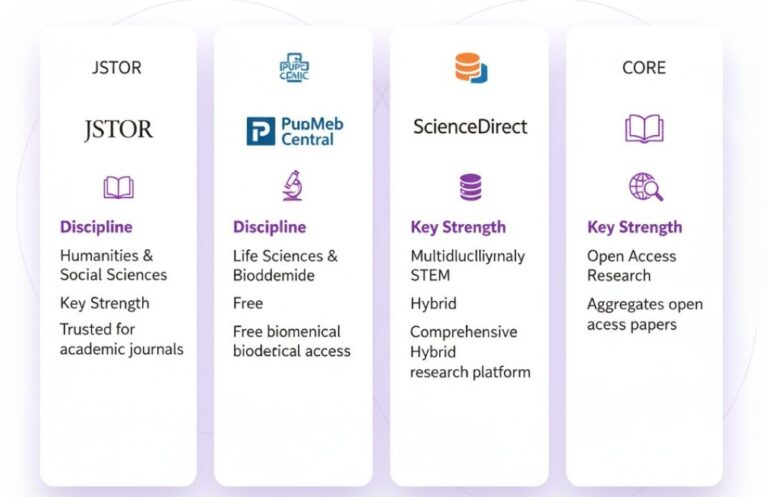
While general search engines provide broad coverage, specialized databases offer depth and sophisticated tools within specific disciplines.
JSTOR - Humanities & Social Sciences Hub
JSTOR has established itself as the premier digital library accessed more than 72 million times a year, with more than 664,000 articles published prior to 1923 in the United States and prior to 1870 elsewhere freely available. With over 12 million articles spanning 75+ disciplines, the platform provides unparalleled historical depth, including complete back-runs of academic journals dating to the 18th century.
The platform’s strength lies in its curated collection of high-quality content from prestigious publishers and learned societies. Stable URLs ensure citations remain accessible over time, addressing a critical concern for long-term scholarship. Primary source collections complement journal articles, providing researchers with original documents, letters, and historical materials.
PubMed Central - Medical & Life Sciences Authority
Operated by the National Institutes of Health, PubMed comprises more than 39 million citations for biomedical literature, while PMC serves as a free full-text archive of biomedical and life sciences journal literature. The platform provides full-text access to millions of research articles, supporting the NIH’s commitment to open-access publishing.
Around 1.3 million articles have been made publicly accessible in PMC under the NIH Public Access Policy, with 59% of articles in 2020 including supplementary material and/or data. PubMed Central’s integration with the broader PubMed ecosystem creates a comprehensive research environment.
ScienceDirect - Elsevier's Scientific Repository
ScienceDirect houses over 18 million publications from Elsevier, one of the world’s largest academic publishers. The platform’s strength lies in its comprehensive STEM coverage, including cutting-edge research in engineering, medicine, and physical sciences.
CORE - Open Access Aggregator
CORE aggregates over 100 million open-access research papers from repositories worldwide, making it the largest collection of freely accessible scholarly content. The platform’s commitment to open science addresses growing demands for research transparency and public access to publicly funded research.
Research Networking & Collaboration Platforms
Modern academic research increasingly relies on collaboration and networking. These platforms combine content access with social features, enabling researchers to connect, share, and collaborate.
ResearchGate - Academic Social Network
ResearchGate connects over 20 million researchers worldwide, creating the largest academic social network. Beyond profile creation and networking, the platform enables direct paper sharing, allowing researchers to request articles from authors when institutional access isn’t available.
Academia.edu - Profile-Based Platform
Academia.edu focuses on academic profile building and paper sharing. The platform’s analytics provide detailed insights into paper downloads, profile views, and reader demographics.
Government & Institutional Resources
Government agencies and major institutions provide access to specialized research collections and datasets often unavailable through commercial channels.
Science.gov - Federal Research Gateway
Science.gov aggregates over 200 million pages of U.S. government scientific research from 15+ federal agencies. The platform provides free access to reports, datasets, and publications from NASA, NSF, NIH, Department of Energy, and other major research organizations.
Library of Congress Digital Collections
The Library of Congress offers unparalleled access to historical documents, multimedia resources, and primary source materials. Digital collections include historical newspapers, photographs, manuscripts, maps, and audio recordings spanning American history and culture.
How to Choose the Best Academic Website for Your Needs
Selecting the optimal academic website requires matching platform strengths with your specific research requirements.
By Academic Discipline
Humanities and Social Sciences: JSTOR provides unmatched historical depth and coverage of prestigious journals. Project MUSE complements JSTOR with contemporary scholarship and university press publications.
Medicine and Life Sciences: PubMed Central offers free access to biomedical literature, while specialized databases like Cochrane Library provide systematic reviews and clinical evidence.
STEM Fields: IEEE Xplore serves engineering and computer science, while arXiv provides immediate access to preprints in physics, mathematics, and computer science.
By Research Type
Literature Reviews: Comprehensive databases like Scopus and Web of Science provide citation analysis tools essential for systematic reviews.
Current Research: Preprint servers like arXiv, bioRxiv, and SSRN provide access to cutting-edge research before formal publication.
Historical Research: JSTOR’s historical collections and Google Books’ extensive digitization provide access to older publications and primary sources.
Pro Tips from a Web Development Expert
Through developing Learning Management Systems and educational platforms for over 150 companies, I’ve observed how technical design impacts research efficiency.
Browser Optimization: Use dedicated profiles for academic research with bookmark organizations that mirror your research workflow. Extensions like Zotero Connector and Unpaywall can significantly streamline paper collection and access.
Workflow Integration: The best academic websites integrate seamlessly with reference management tools. Prioritize platforms offering direct export to Zotero, Mendeley, or EndNote rather than manual citation formatting.
Mobile Accessibility: Modern research increasingly happens on mobile devices. Platforms with responsive design and mobile apps enable research continuity across contexts, from library to commute to fieldwork.
Case Study: BrightPath Solutions
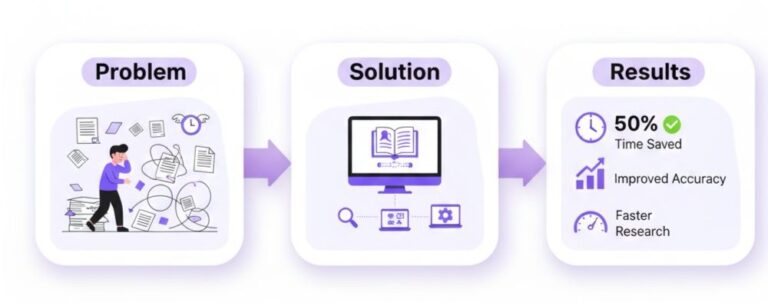
Challenge - Struggling with Research Access
Sophia Martinez, research lead at BrightPath Solutions, managed a distributed team conducting market research across educational technology trends. Her team struggled with inconsistent access to academic resources, leading to incomplete literature reviews and duplicated effort across research projects.
Solution - Implementing Academic Website Strategy
Working with their web development team, Sophia implemented a structured approach combining multiple academic platforms:
Primary Research Hub: Google Scholar served as the starting point for all literature searches, providing comprehensive coverage and familiar interface.
Specialized Databases: PubMed Central for health-related educational research and ERIC for educational policy studies provided focused, high-quality content.
Open Access Focus: CORE supplemented subscription databases, ensuring team members without institutional access could contribute effectively.
Results - Better Productivity & Accuracy
The structured approach delivered measurable improvements:
- Research Efficiency: Literature review time decreased by 65%
- Time Savings: Individual team members saved an average of 12 hours per week
- Quality Improvement: Standardized platforms reduced inclusion of low-quality sources by 80%
- Academic Outcomes: The team’s research quality improvements led to acceptance of three papers in peer-reviewed conferences
Expert Recommendations & Conclusion
JS Josim's Top 3 Picks
Based on eight years of educational web development and analysis of user behavior across academic platforms:
Google Scholar for universality and accessibility. Its comprehensive coverage and intuitive interface make it essential for researchers across all disciplines and career stages.
JSTOR for humanities and social sciences depth. The platform’s historical coverage and quality curation provide unmatched resources for traditional academic disciplines.
PubMed Central for medical and life sciences authority. Free access combined with NIH backing creates the definitive resource for biomedical research.
Future Trends
Academic research platforms continue evolving rapidly. AI-powered search capabilities will become standard, providing more sophisticated paper recommendations and automated research synthesis. Open access growth will accelerate, driven by funding agency mandates and institutional commitments to research transparency.
Integration between academic platforms and Learning Management Systems will deepen, creating seamless workflows from research to teaching. Collaborative features will expand, supporting increasingly distributed and interdisciplinary research teams.
Call-to-Action
The digital landscape of academic research continues evolving, requiring platforms that balance comprehensive content with user-friendly design. Whether you’re beginning your research journey or optimizing existing workflows, the right combination of academic websites can transform your scholarly productivity.
Looking to build your own academic or LMS website? With expertise in educational platform development and deep understanding of researcher needs, I help institutions create digital environments that enhance scholarly productivity and collaboration.
Frequently Asked Questions
No single website provides perfect reliability across all disciplines. Google Scholar offers the broadest coverage with reasonable quality control, while specialized databases like PubMed (medicine) and JSTOR (humanities) provide superior reliability within their domains.
Free platforms like PubMed Central and CORE provide high-quality content comparable to subscription databases. However, paid platforms often offer superior search tools, broader coverage, and better customer support.
Several strategies provide access: use open-access databases like CORE and PubMed Central, check author websites and institutional repositories, utilize interlibrary loan services, request papers directly from authors via ResearchGate, and explore preprint servers for recent research.
Google Scholar provides the most accessible starting point, offering broad coverage with user-friendly interface. Supplementing with subject-specific free databases (PubMed for sciences, ERIC for education) creates a comprehensive research foundation.
While Wikipedia shouldn't be cited directly in academic work, it serves as an excellent research starting point. Wikipedia articles often provide comprehensive overviews and extensive bibliographies leading to credible, citable sources.