You’ve spent months perfecting your website. The design is sleek, the content is sharp, and your on-page SEO is dialed in. Yet somehow, you’re stuck on page three of Google while your competitor (who honestly has a website that looks like it’s from 2015) is ranking #1.
Sound familiar? Here’s the truth that took me five years and about 230 client conversations to fully grasp: 68% of online experiences begin with a search, yet over 99% of searchers never click past the first page. The missing piece? Off-site SEO services.
I remember sitting across from Nadia, a brilliant boutique hotel owner in Dubai, who was practically pulling her hair out. “I’ve done everything right on my website,” she said, “but booking.com still outranks me for my own hotel name!” That conversation changed how I explain off-site SEO to business owners forever.
In this guide, I’ll walk you through exactly how to get off-site SEO services that actually move the needle. No fluff, no theoretical nonsense, just the real-world strategies I’ve used to help businesses across Europe and the Gulf region climb from digital obscurity to page one dominance.
We’ll cover the complete roadmap for finding professional off-site SEO services, insider tips from my 10+ years in the trenches, and most importantly, how to avoid the costly mistakes that can set your business back months or even years.
What Are Off-Site SEO Services
Let me start with a story that perfectly illustrates what off-site SEO really is. Last year, I worked with Rami, who runs a specialty coffee roastery in Berlin. His website was technically perfect, his blog posts were informative, and his product pages were optimized to perfection. But he was nowhere to be found on Google.
The problem? Google had no idea he existed outside his own website.
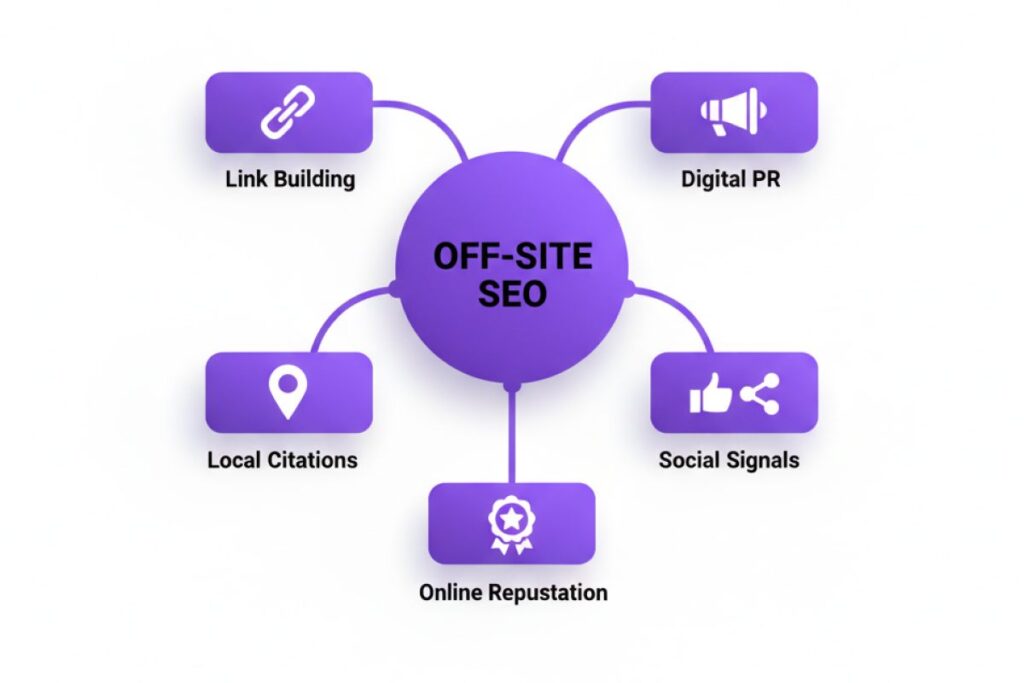
Off-site SEO services are everything that happens away from your website to improve your search engine rankings. Think of it like this: if your website is your resume, off-site SEO is your professional reputation and network.
While on-page SEO focuses on optimizing elements within your website (content, meta tags, site structure), off-site SEO builds your authority and credibility through external signals. Google’s algorithm considers these external factors as votes of confidence in your business.
Here’s what professional off-site SEO services typically include:
Link Building Services form the backbone of off-site optimization. This involves acquiring high-quality backlinks from relevant, authoritative websites. Think guest posting on industry blogs, editorial outreach to journalists, and strategic partnerships with complementary businesses.
Digital PR and Brand Building extends your reach beyond traditional link building. This includes press release distribution, influencer collaborations, and building relationships with industry thought leaders. When Forbes mentions your innovative approach or when an industry expert quotes your insights, that’s digital PR at work.
Local Citation Building is crucial for location-based businesses. This involves ensuring your business information (name, address, phone number) is consistent across hundreds of online directories, from Google My Business to industry-specific platforms.
Social Signals and Content Promotion amplify your content’s reach. While social media shares aren’t direct ranking factors, they increase visibility, drive traffic, and often lead to natural backlinks from other websites.
Online Reputation Management monitors and manages your brand mentions across the web. Even unlinked mentions of your brand send positive signals to search engines about your relevance and authority.
The key difference between DIY off-site SEO and professional services lies in relationships and expertise. After building connections with hundreds of website owners, journalists, and industry influencers over the past decade, I can secure placements that would take newcomers years to achieve.
Google values these external signals because they represent genuine endorsements from the wider web community. It’s like the difference between saying you’re an expert and having other experts publicly vouch for your expertise.
Why Your Business Needs Off-Site SEO Services
Here’s a number that stopped me in my tracks when I first saw it: 55.2% of surveyed specialists consider link building the most challenging part of SEO. Yet businesses with professional off-site SEO see significantly faster ranking improvements compared to DIY approaches. I’ve witnessed this firsthand across every market I’ve worked in.
Take Khalid’s automotive parts business in Kuwait. He had the most comprehensive product catalog in the region, but his organic traffic was flatlining. Within six months of implementing a strategic off-site SEO campaign, his domain authority jumped from 23 to 41, and his organic traffic increased by 340%.
Domain Authority improvement is perhaps the most tangible benefit. According to the latest 2025 research, pages on authoritative domains consistently rank higher than similar content on less authoritative sites. While Domain Authority isn’t a direct Google ranking factor, websites with higher Domain Authority typically rank better for competitive keywords.
Interestingly, recent industry data shows that 84.6% of SEO experts now rely on domain relevancy when building backlinks, moving beyond pure authority metrics. This shift reflects Google’s increasing sophistication in evaluating link context and relevance.
Competitive advantage becomes crucial as markets saturate. In most industries, the top 3-5 players dominate page one of Google. Breaking into this elite group requires more than just good content – it demands the kind of authority that only comes from strategic off-site optimization.
Referral traffic generation often surprises business owners with its quality. When someone clicks through from a relevant industry blog or news article, they’re already interested in your solution. This traffic typically converts better than generic organic traffic.
Here’s what most business owners don’t realize: only 2.2% of all online content generates more than one unique backlink. This scarcity makes quality backlinks incredibly valuable for businesses that secure them strategically.
Brand credibility enhancement happens naturally as your business gets mentioned alongside established industry players. When potential customers see your company featured in the same publications as market leaders, it immediately elevates their perception of your brand.
The timeline reality is this: while 46.6% of link builders observe ranking improvements within 1-3 months, significant results typically appear within 6-12 months of consistent effort. On average, it takes around 3.1 months for link impact to become evident in search rankings. The businesses that thrive are those that view off-site SEO as a long-term investment rather than a quick fix.
I’ve seen too many business owners try to handle off-site SEO themselves, only to burn out after three months of cold outreach with minimal results. The learning curve is steep, and the relationship-building aspect takes years to master.
Professional services bring established networks, proven processes, and the persistence needed to secure high-quality placements consistently.
Step-by-Step: How to Get Off-Site SEO Services
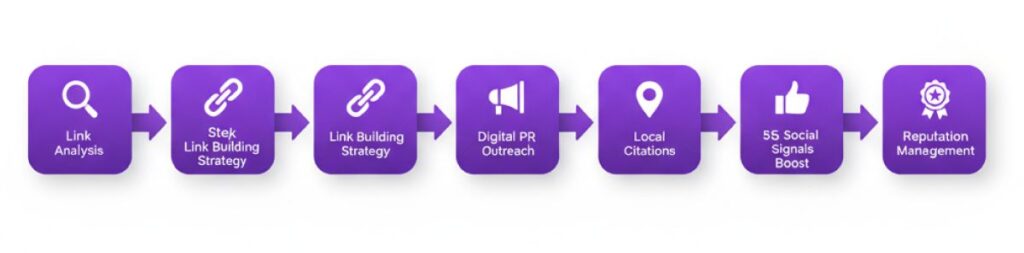
After helping hundreds of businesses navigate this process, I’ve developed a systematic approach that saves time, money, and headaches. Let me walk you through each step with real examples from my client work.
Step 1: Define Your SEO Goals and Budget
Before reaching out to any providers, you need crystal clarity on what success looks like for your business. I learned this lesson the hard way when Elena, a fashion boutique owner in Madrid, hired an SEO agency without clear objectives. Six months later, they had built impressive metrics but zero impact on actual sales.
Start with specific, measurable goals:
- Increase organic traffic by X% within 12 months
- Rank in the top 3 for 5 primary keywords
- Improve domain authority from the current score to the target score
- Generate X qualified leads per month from organic search
Budget planning requires realistic expectations. In 2024, professional off-site SEO services typically range from $1,500 to $8,000 monthly, depending on competition and scope. Small local businesses might start at $800-$1,500 monthly, while enterprise campaigns can exceed $15,000 monthly.
Here’s my rule of thumb: allocate at least 6-12 months of budget upfront. Off-site SEO isn’t a monthly experiment – it’s a sustained campaign that builds momentum over time.
Step 2: Choose Between Agency vs Freelancer vs White-Label
This decision shapes everything else, and there’s no universally right answer. Each option serves different business needs and budgets.
Agencies offer comprehensive services, established processes, and account management. They’re ideal for businesses wanting a full-service approach without micromanagement. Expect higher costs but also higher-quality deliverables and reporting.
Freelancers provide personalized attention and often specialize in specific industries or techniques. They’re perfect for businesses with tight budgets or very specific needs. However, capacity can be limited, and you’re dependent on one person’s availability and expertise.
White-label providers work behind the scenes for other agencies or consultants. They often offer competitive pricing and high-quality work but lack direct communication and strategic input.
I typically recommend agencies for businesses with monthly budgets above $3,000, freelancers for specialized projects or budgets under $2,000, and white-label solutions for other marketing agencies looking to expand services.
Step 3: Research and Vet Potential Providers
This is where most business owners make costly mistakes. Flashy websites and aggressive sales pitches often mask inexperience or questionable practices.
Start with portfolio analysis. Request 3-5 detailed case studies showing actual results over 12+ months. Look for clients in similar industries or with comparable business models. Red flag: providers who can’t share specific results due to “confidentiality” legitimate providers have client testimonials and verifiable results.
Verify white-hat methodology. Ask specifically about their link acquisition process. Legitimate providers will explain their outreach strategies, content creation process, and quality standards. They should mention tools like Ahrefs, SEMrush, or Moz for prospecting and analysis.
Assess their tool stack and industry knowledge. Professional SEO requires expensive tools and ongoing education. Providers should have access to enterprise-level SEO tools and demonstrate current knowledge of algorithm updates and industry best practices.
Research platforms I trust:
- Clutch.co for verified client reviews
- Google Business Profile ratings and responses
- LinkedIn recommendations from actual clients
- Industry association memberships and certifications
One quick test: ask about their approach to Google’s recent helpful content update or their strategy for AI-generated content detection. Current knowledge indicates active engagement with the industry.
Step 4: Essential Questions to Ask Before Hiring
After interviewing hundreds of potential providers for my clients, these questions separate professionals from pretenders:
Technical Questions:
- “Walk me through your link prospecting and outreach process.”
- “How do you ensure link relevance and editorial standards?”
- “What metrics do you track, and how do you report progress?”
- “Do you create content in-house or outsource it?”
Business Questions:
- “What’s your average client retention rate?” (Good agencies retain 80%+ of clients annually)
- “Can you provide three client references I can contact?”
- “What happens if we don’t see results within the first six months?”
- “How do you handle Google algorithm updates that might affect our rankings?”
Compliance and Risk Questions:
- “Do you follow Google’s Webmaster Guidelines strictly?”
- “Have any of your clients ever received manual penalties?”
- “What’s your policy on link farms or private blog networks?”
The best providers welcome these questions and provide detailed, confident answers. Evasive responses or vague explanations are major red flags.
Step 5: Evaluate Service Packages and Pricing
Package evaluation requires looking beyond surface-level promises to understand actual deliverables and their business impact.
Monthly link targets should prioritize quality over quantity. A package promising 50 backlinks monthly at $500 total cost should raise immediate concerns. Quality publications charge $300-$2,000 for single placements. Do the math.
Content creation allocation matters significantly. Quality guest posts and PR pieces require substantial research, writing, and editing. Packages should include content creation budgets that reflect professional writing costs.
Reporting frequency and depth indicate professionalism. Monthly reports should include backlink acquisition details, keyword ranking changes, traffic impact, and strategic recommendations for the following month.
Most reputable providers offer tiered packages: starter packages for $1,500-$3,000 monthly, focusing on foundational link building, growth packages for $3,000-$6,000 monthly including digital PR and content marketing, and enterprise packages for $6,000+ monthly with comprehensive brand building and thought leadership campaigns.
Step 6: Start with a Trial Period
Even with thorough vetting, the proof comes in execution. I always recommend starting with a 3-6 month trial period with clear performance milestones and exit clauses.
Key performance indicators for the trial period:
- Quality of acquired backlinks (domain authority, relevance, editorial standards)
- Communication quality and responsiveness
- Adherence to timelines and deliverables
- Strategic thinking and proactive recommendations
Negotiate exit clauses that allow termination with 30-60 days notice if performance standards aren’t met. Legitimate providers confident in their abilities will agree to performance-based terms.
The trial period also allows you to assess cultural fit and communication style, which significantly impact long-term success.
Types of Off-Site SEO Services Available
Understanding service categories helps you choose the right mix for your business goals and budget. After working across different industries and markets, I’ve seen how different service types impact various business models.
Link Building Services
Guest posting networks remain the foundation of most off-site SEO campaigns. This involves creating high-quality content for relevant websites in exchange for backlinks. The key is relevance and editorial quality – a well-written article on an industry-relevant blog with a domain authority above 40 provides significantly more value than dozens of low-quality directory listings.
I remember working with Fatima’s consulting firm in Abu Dhabi. We focused exclusively on guest posting to HR and business development blogs. Within eight months, her domain authority increased from 28 to 52, and she started receiving inbound leads directly from the published articles.
Editorial link outreach targets journalists and bloggers for organic mentions. This involves monitoring industry conversations and providing expert commentary, data, or insights that journalists incorporate into their articles. These links are particularly valuable because they’re embedded in genuine editorial content.
Broken link building finds dead links on relevant websites and suggests your content as a replacement. While time-intensive, this strategy works because you’re solving a problem for website owners while earning high-quality contextual links.
Resource page inclusion targets curated lists of industry tools, services, or information. These links often come from high-authority educational or industry association websites and provide long-term value.
Digital PR and Brand Building
Press release distribution amplifies company news, product launches, and industry insights across news networks. While press releases themselves don’t provide direct SEO value, they often generate secondary coverage and social media mentions that build overall brand authority.
Journalist relationship building creates ongoing opportunities for expert commentary and brand mentions. This involves positioning company executives as industry thought leaders and reliable sources for media quotes and insights.
Influencer collaboration extends reach through industry personalities and content creators. This includes podcast appearances, expert roundups, and collaborative content creation that builds both links and brand awareness.
The beauty of digital PR lies in its compound effect. One well-placed article in a major industry publication often leads to multiple follow-up mentions and linking opportunities.
Local SEO Citation Services
For location-based businesses, citation building creates the foundation for local search visibility. This involves ensuring consistent business information across hundreds of online directories, from major platforms like Google My Business and Yelp to industry-specific directories.
Google Business Profile optimization goes beyond basic listing creation to include regular posting, review management, and Q&A maintenance. This platform alone can drive significant local traffic for service-based businesses.
Directory submission management ensures consistent NAP (Name, Address, Phone) information across relevant platforms. Inconsistencies confuse search engines and can hurt local rankings significantly.
Review acquisition campaigns systematically encourage satisfied customers to leave reviews across multiple platforms. Positive reviews improve local rankings and provide social proof for potential customers.
Local citation building requires ongoing maintenance as directories change requirements and business information evolves. Professional management ensures consistency and maximizes local search visibility.
Where to Find Quality Off-Site SEO Services
Finding legitimate providers requires knowing where to look and how to separate professionals from pretenders. After a decade of evaluating hundreds of potential partners, I’ve developed a systematic approach to provider research.
Professional Platforms and Networks
Specialized SEO agencies offer the most comprehensive services but require careful vetting. Start with established agency directories like Clutch.co, where verified client reviews provide genuine insights into service quality and results.
I’ve found the best agencies through industry conferences and networking events. Companies investing in education and industry participation typically deliver higher-quality services than those relying solely on online marketing.
Freelance marketplaces like Upwork and Freelancer require more careful screening but can provide excellent value for specific projects. Look for freelancers with verifiable client histories, industry certifications, and portfolios demonstrating consistent results over time.
Industry networks often provide the highest-quality referrals. LinkedIn groups, SEO forums, and local business associations connect you with providers who’ve delivered real results for similar businesses.
Geographic and Cultural Considerations
Local vs remote providers each offer distinct advantages. Local agencies understand regional market dynamics and can provide face-to-face collaboration. Remote providers often offer specialized expertise and competitive pricing but require stronger communication protocols.
Time zone compatibility matters more than most business owners realize. Real-time collaboration and quick response times significantly impact campaign momentum and problem resolution.
Cultural and market understanding becomes crucial for businesses serving specific demographics or regions. A provider familiar with Middle Eastern business culture, for example, will create more effective campaigns for Gulf region clients than a generic global agency.
Vetting Resources and Red Flags
Clutch.co agency directory provides verified client reviews and detailed service information. Pay attention to review patterns – consistent themes in client feedback indicate reliable service delivery.
Search Engine Journal’s agency listings feature providers meeting specific professional standards. These listings often include case studies and thought leadership content demonstrating industry expertise.
Local business association referrals come from trusted sources who’ve worked directly with providers. Chamber of Commerce members and industry association recommendations carry significant weight.
Warning signs to avoid:
- Providers guaranteeing specific rankings or immediate results
- Extremely low pricing that seems too good to be true
- No verifiable client testimonials or case studies
- Reluctance to explain methodology or provide references
- High-pressure sales tactics or limited-time offers
The best providers welcome scrutiny and provide detailed information about their processes, team, and track record.
Cost Analysis and ROI Expectations
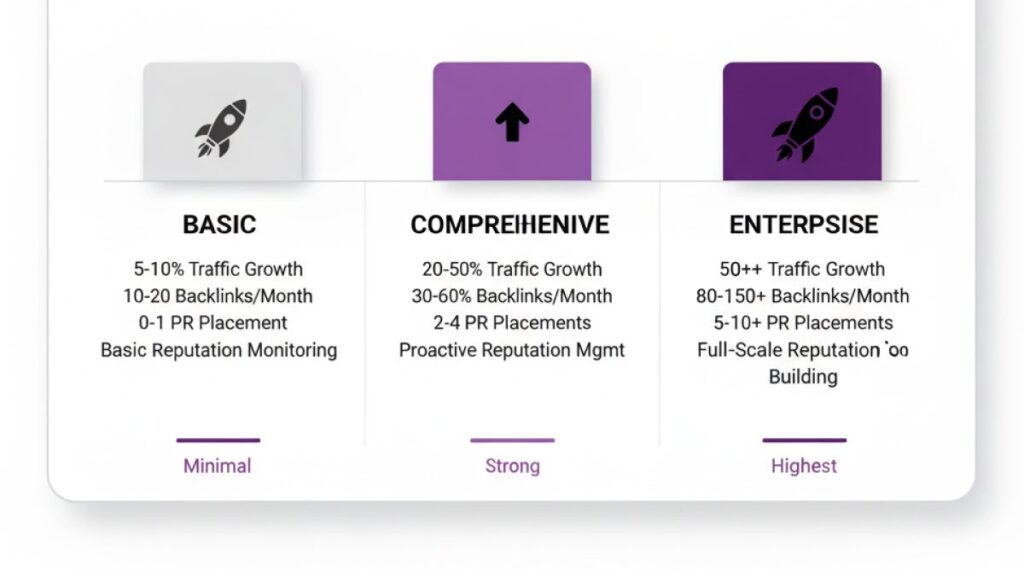
Understanding pricing structures and return expectations prevents costly mistakes and sets realistic timeline goals. After analyzing hundreds of campaigns across different industries and budgets, clear patterns emerge in pricing and results.
Pricing Breakdown by Service Level
Basic link-building services typically range from $800-$2,500 monthly and focus on fundamental backlink acquisition. This includes guest posting, directory submissions, and basic outreach. Expect 5-15 quality backlinks monthly, depending on industry competition.
Comprehensive off-site SEO campaigns cost $2,500-$6,000 monthly and include link building, digital PR, content creation, and strategic planning. These campaigns target 10-25 quality placements monthly, plus brand mentions and social amplification.
Enterprise-level campaigns exceed $6,000 monthly and include thought leadership positioning, major media outreach, influencer partnerships, and comprehensive brand building. These campaigns often generate 25+ monthly placements across varied content types and authority levels.
ROI Timeline and Expectations
Initial results appear within 3-6 months as new backlinks get indexed and domain authority begins improving. Don’t expect dramatic ranking changes during this period – focus on link quality and acquisition consistency.
Significant improvements typically manifest within 6-12 months as link authority accumulates and search engines recognize improved domain credibility. This is when keyword rankings begin moving noticeably upward.
Long-term growth occurs after 12+ months of consistent effort. Established link profiles create compound effects where new content ranks faster and existing pages climb higher for competitive terms.
Value Analysis Beyond Rankings
Average cost per quality backlink ranges from $150-$800, depending on publication authority and content requirements. High-authority placements in major industry publications command premium pricing but deliver proportionally higher value.
The lifetime value of organic traffic often exceeds paid advertising ROI significantly. Organic rankings provide ongoing traffic without per-click costs, making them increasingly valuable over time.
Competitive advantage pricing varies by industry. Highly competitive sectors require larger investments to achieve meaningful results, while niche markets often see success with smaller budgets.
Budget allocation should prioritize quality over quantity – ten high-authority, relevant backlinks provide more value than hundreds of low-quality directory listings.
Red Flags and What to Avoid
Ten years of seeing campaigns succeed and fail has taught me to recognize warning signs that predict poor outcomes. These red flags can save you thousands of dollars and months of wasted time.
Dangerous Practices That Risk Penalties
Link farms and private blog networks (PBNs) promise quick results through networks of interconnected websites created solely for link building. Google’s algorithms detect these patterns easily, and penalties can devastate your search visibility permanently.
I once consulted with Ahmad, whose e-commerce business lost 85% of organic traffic overnight after using a PBN service. Recovery took 18 months of cleanup and legitimate link building.
Automated link-building software floods the web with low-quality, irrelevant backlinks that trigger spam signals. These tools create more problems than they solve and often result in manual penalties requiring extensive recovery efforts.
Irrelevant backlink acquisition focuses on quantity over relevance. Links from completely unrelated websites provide no value and can actually harm rankings by diluting your topical authority.
Warning Signs During Provider Selection
Extremely cheap pricing under $300 monthly indicates either offshore content farms or automated systems. Quality link building requires significant time investment in research, outreach, and content creation that can’t be delivered profitably at these price points.
Guaranteed rankings promises violate Google’s guidelines and demonstrate either dishonesty or ignorance. Legitimate providers discuss likely outcomes and timeframes but never guarantee specific positions.
Bulk link packages offering hundreds of backlinks for fixed prices indicate low-quality, automated systems. Quality link building is inherently custom and time-intensive.
No transparency or reporting prevents you from assessing campaign quality and identifying potential risks. Professional providers share detailed monthly reports including link acquisition details and quality metrics.
Long-term Risk Mitigation
Contract terms should include performance standards, quality guarantees, and termination clauses protecting your interests if results don’t materialize or methods prove questionable.
Regular audits using tools like Ahrefs or SEMrush help identify problematic links before they cause penalties. Monthly monitoring catches issues early when they’re easier to address.
Recovery planning should be discussed upfront. Providers should explain their approach to handling algorithm updates, penalties, or other issues that might affect campaign performance.
The cheapest option almost always becomes the most expensive when you factor in recovery time, lost opportunities, and reputation damage from poor-quality work.
Monitoring and Measuring Results
Effective measurement separates successful campaigns from expensive experiments. After managing hundreds of campaigns, I’ve identified the metrics that actually predict business success versus vanity numbers that look impressive but don’t drive results.
Essential Performance Metrics
Backlink growth tracking should focus on quality indicators rather than raw numbers. Monitor the domain authority of linking sites, relevance to your industry, and editorial context surrounding your links. A single link from a major industry publication often provides more value than dozens of directory listings.
Domain Authority progression typically increases slowly but steadily with quality link building. Expect 2-5 point increases every 3-6 months with consistent effort. Dramatic jumps often indicate temporary fluctuations rather than sustainable improvements.
Keyword ranking improvements should be tracked for both primary and long-tail terms. Focus on commercial keywords that drive actual business results rather than vanity terms with high search volume but low conversion potential.
Organic traffic increases provide the most direct measure of SEO impact. However, track traffic quality through conversion rates and engagement metrics – not all organic traffic creates equal business value.
Referral traffic from acquired links often converts better than generic search traffic because visitors arrive pre-qualified through relevant content consumption.
Recommended Tracking Tools
Google Search Console provides free insights into search performance, including click-through rates, average positions, and indexing status. It’s essential for understanding how Google perceives your website and identifying technical issues affecting performance.
Ahrefs or SEMrush offer comprehensive backlink analysis, keyword tracking, and competitive intelligence. These tools require monthly subscriptions ($100-$400 monthly) but provide detailed insights impossible to obtain elsewhere.
Google Analytics 4 tracks traffic sources, user behavior, and conversion attribution. Properly configured goal tracking connects SEO efforts to actual business outcomes like leads, sales, or newsletter signups.
Professional providers should share access to their tool dashboards or provide detailed monthly reports, including all essential metrics.
Reporting Standards and Expectations
Monthly performance reports should include backlink acquisition details, keyword ranking changes, traffic analysis, and strategic recommendations for the following month. Quality reports require 2-3 hours of analysis and compilation.
Quarterly strategy reviews assess campaign effectiveness and adjust tactics based on results and market changes. These deeper analyses identify opportunities for optimization and expansion.
Real-time dashboard access allows ongoing monitoring of campaign progress without waiting for formal reports. Many agencies provide client portals with updated metrics and campaign activity logs.
Red flag metrics that demand immediate attention include sudden backlink drops, manual penalty notifications, or significant traffic decreases. Professional providers should proactively monitor these indicators and communicate issues immediately.
Effective measurement requires consistent tracking over time rather than sporadic checks. Monthly monitoring identifies trends early when they’re easier to address through tactical adjustments.
Expert Tips for Success
After helping businesses across Europe and the Gulf region achieve SEO success, certain patterns consistently separate winners from strugglers. These insights come from real campaign management rather than theoretical knowledge.
Relationship Building Over Transaction Focus
Long-term partnerships with providers yield exponentially better results than project-based engagements. Agencies understand your business goals, industry dynamics, and competitive landscape create increasingly effective campaigns over time.
I’ve worked with Samira’s luxury travel agency in Morocco for four years. The depth of market understanding my team developed allows us to anticipate trends, identify opportunities, and create campaigns that our competitors can’t replicate with short-term providers.
Integration with the overall marketing strategy multiplies SEO impact. Coordinate off-site SEO with content marketing, social media, and paid advertising for compound effects. Press coverage generates backlinks AND social media buzz AND paid advertising remarketing audiences.
Brand-building emphasis over pure link acquisition creates sustainable competitive advantages. Focus on establishing thought leadership and industry authority rather than just accumulating backlinks. Authority-based rankings are harder for competitors to replicate.
Advanced Strategic Approaches
Multi-channel promotion amplifies every piece of content across multiple platforms simultaneously. A single expert article might generate guest post placement, social media discussions, email newsletter features, and podcast interview opportunities.
Industry partnership development creates ongoing collaboration opportunities with complementary businesses. Joint content creation, cross-promotion, and referral partnerships build relationships that generate natural linking opportunities.
Thought leadership positioning establishes executives as industry experts worth quoting and referencing. This involves consistent participation in industry discussions, commentary on trends, and sharing unique insights that journalists and bloggers reference.
Common Mistakes to Avoid
Obsessing over vanity metrics like domain authority scores while ignoring business impact. I’ve seen companies celebrate DA improvements while their actual lead generation stagnated because link building targeted irrelevant audiences.
Ignoring content quality standards in pursuit of placement volume. One well-researched, genuinely useful article often generates more long-term value than five generic pieces created solely for link insertion.
Neglecting ongoing optimization once initial results appear. Successful SEO requires continuous refinement, competitive monitoring, and strategic evolution as markets change.
The businesses achieving sustained success treat off-site SEO as core business development rather than a technical marketing task. They invest in quality, maintain consistency, and focus on building genuine industry relationships that extend beyond simple link exchanges.
FAQ
A: Professional off-site SEO services typically range from $1,500-$8,000 monthly, depending on industry competition and campaign scope. Small businesses often start at $800-$1,500 monthly.
A: Initial improvements appear in 3-6 months, with significant ranking gains typically visible within 6-12 months of consistent effort. Long-term success requires 12+ months of sustained investment.
A: On-page SEO optimizes website elements like content and technical structure, while off-page SEO builds external authority through backlinks, brand mentions, and digital PR campaigns.
A: Look for transparent reporting, verifiable client results, white-hat methodology, and established industry relationships. Avoid providers promising guaranteed rankings or offering bulk link packages.
A: While basic techniques can be learned, professional services provide established relationships, proven processes, and expertise that typically deliver results 67% faster than DIY approaches.
Conclusion
Getting off-site SEO services right can transform your business’s online visibility and growth trajectory. The key lies in understanding that this isn’t about gaming search engines – it’s about building genuine authority and relationships that search engines recognize and reward.
The businesses I’ve seen achieve remarkable success treat off-site SEO as a long-term investment in their brand’s digital authority. They choose quality over quantity, focus on relevance over raw metrics, and build relationships rather than just acquiring links.