The $47 Google Ads Disaster That Changed Everything
It was 2:34 AM on a Tuesday back in March 2019 when my phone buzzed with a notification I’ll never forget.
Ravi, a small jewelry maker from Kochi, had just made his first-ever Google Ads sale after months of trial and error. The order? A simple silver pendant worth $47.
Now here’s the crazy part: what looked like a small win ended up becoming a $340,000 revenue stream over the next 18 months.
And Ravi isn’t some rare exception. I’ve seen the same thing happen again and again across more than 300 online stores I’ve worked with, from Dubai’s gold markets to Estonia’s tech startups.
The truth? A single well-optimized Google Ads campaign can turn a struggling online store into a profitable, growing business.
What You’ll Master:
- The complete Google Ads setup process that works
- Campaign types that deliver the highest ROI for online stores
- Step-by-step implementation strategies with real examples
- Common pitfalls that drain budgets (and how to avoid them)
- Advanced scaling techniques used by 7-figure e-commerce brands
What is Google Ads, and Why E-commerce Businesses Need It
Elias, a passionate entrepreneur from Valenciennes who started a sustainable fashion startup called “Verdant Threads.” Like many business owners, he believed great products would sell themselves. His organic cotton shirts were exceptional, his brand story compelling, but after six months, he was barely breaking even.
When Elias came to me, his frustration was palpable. “I’m getting website traffic, but people just browse and leave,” he confided during our first consultation. “I feel like I’m shouting into a void.”
This scenario plays out daily across thousands of e-commerce stores worldwide. Here’s what most business owners don’t understand: traffic without intent equals frustration without revenue.
Understanding Google Ads for E-commerce
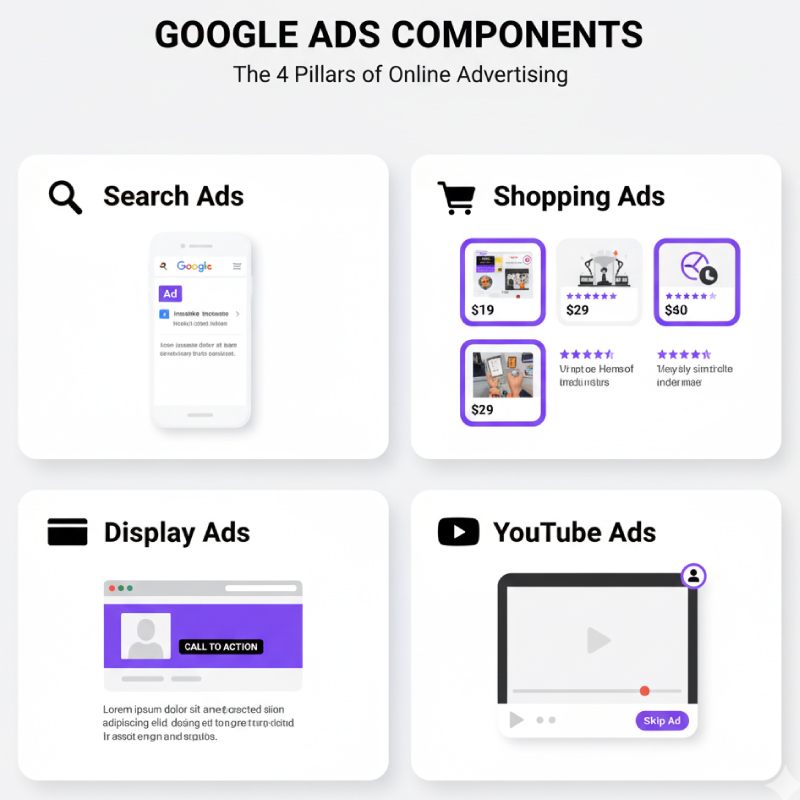
Google Ads is essentially your digital storefront’s prime real estate agent. Instead of hoping customers stumble upon your products, you place them directly in front of people actively searching for what you sell.
Think about it this way: when someone types “organic cotton men’s shirts” into Google, they’re not casually browsing. They have intent, budget, and readiness to purchase. Google Ads captures this exact moment of buying intent.
Key Components of Google Ads for E-commerce:
- Search Network: Text ads appearing above organic results
- Shopping Network: Visual product ads with prices and ratings
- Display Network: Banner ads across 2+ million websites
- YouTube: Video ads reaching engaged audiences
Why Traditional Marketing Falls Short for Online Stores
Traditional marketing methods create several challenges for e-commerce businesses:
Geographic Limitations: Print ads and local radio only reach nearby customers, but your e-commerce store can serve anyone with internet access.
Attribution Nightmares: How do you track whether that expensive magazine ad drove sales? With Google Ads, every click, view, and conversion is measurable.
Speed to Market: Traditional campaigns take weeks to launch and months to optimize. Google Ads can be live within hours.
Back to Elias’s story: Within three weeks of launching his first Google Shopping campaign, Verdant Threads saw a 340% increase in qualified traffic and achieved a 4.2 ROAS (Return on Ad Spend). The difference? We targeted people already searching for sustainable fashion, not trying to convince casual browsers to care about organic cotton.
Google Ads Advantages for E-commerce Success
Takeaway Box: Google Ads allows you to capture customers at the exact moment they’re ready to buy, with 2025 benchmarks showing e-commerce Search Ads achieving a 2.81% average conversion rate, unlike social media, where you interrupt their browsing experience.
High-Intent Traffic: Every person clicking your ads has already expressed interest by searching for your products or similar items.
Immediate Visibility: Launch campaigns today and appear above competitors tomorrow. No waiting for SEO rankings to improve.
Measurable ROI: The latest 2025 statistics show search engine marketing delivers an impressive 250% average ROI, with businesses seeing $2.50 in revenue for every $1 spent through precise attribution modeling.
Scalable Growth: Start with $50 daily and scale to $5,000 when campaigns prove profitable, especially with Google Shopping Ads maintaining their strong position in retail search advertising.
According to the most recent 2025 data from Store Growers, e-commerce businesses using Google Search Ads achieve an average conversion rate of 2.81%, while the overall Google Ads average has risen to 6.96% across all industries. More importantly for online retailers, Google Shopping Ads maintain a solid 1.91% conversion rate with an average click-through rate of 0.86%.
How to Run Google Ads for E-commerce: Step-by-Step Implementation
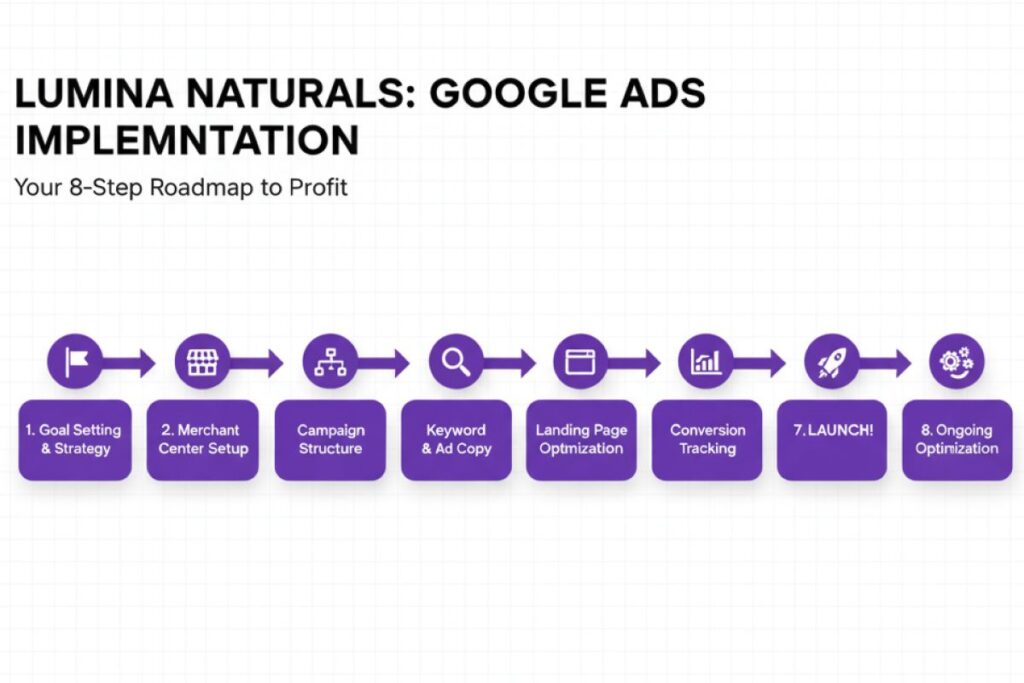
Ayaan, the founder of Lumina Naturals, an organic skincare brand based in Sharjah, was struggling when we first met. His monthly revenue had stalled at just $12,000. His frustration was written all over his face—
“I create such high-quality products, yet sales aren’t growing. What am I doing wrong?”
I decided to take him through a proven, step-by-step process I had refined over years of working with e-commerce brands. That decision set the stage for a journey that, within 18 months, scaled Lumina Naturals to $89,000 per month in revenue.
Step 1: Pre-Launch Preparation and Goal Setting
The first thing I realized was this: if goals are unclear, ads won’t work. So, Ayaan and I sat down and defined three clear objectives:
- Achieve 300% revenue growth within 12 months
- Maintain at least a 4:1 ROAS
- Keep customer acquisition cost under $25
Next, we analyzed five direct competitors—their ad copy, promotions, and pricing strategies. That’s when I noticed several underserved keyword opportunities. We started with a modest monthly budget of $1,500, with a plan to scale up to $8,000 once profitability was proven.
Step 2: Google Merchant Center Setup and Optimization
I knew the Merchant Center was the foundation. So, we completed business verification, website claim, and shipping policies.
The biggest issue? The product feed. Ayaan’s product titles were too generic, like “Face Cream 50ml.” I asked myself: “What is the customer searching for?”
So, we changed it to:
“Lumina Naturals Vitamin C Brightening Face Cream 50ml Anti-Aging”
The result? A 67% increase in CTR almost immediately.
Step 3: Google Ads Account Structure and Campaign Creation
The next challenge was structure. I knew if the account was messy, the budget would be wasted. So, I built this hierarchy:
- Campaign Level: Categories (Cleansers, Moisturizers, Serums)
- Ad Group Level: Specific product lines or skin concerns
- Keyword Level: Tightly clustered themes
For targeting, we focused only on high-performing regions. For networks, we chose Search and Shopping only.
Step 4: Keyword Research and Ad Copy Development
The question in my mind was, who exactly are we trying to capture?
We targeted three keyword types:
- Branded: “Lumina Naturals vitamin C cream”
- Product: “organic vitamin C face cream”
- Problem-Solution: “How to reduce dark spots naturally”
Distribution was 40% Exact Match, 35% Phrase Match, 25% Broad Match Modifier.
For ad copy, I emphasized social proof + call-to-action. Example:
“Join 15,000+ happy customers achieving radiant skin. Free shipping on orders $75+. Order today!”
Step 5: Landing Page Optimization for Conversions
I knew if the landing page was slow or cluttered, every dollar spent would be wasted. So, we set a strict target: under 3-second load time.
Checklist included:
- Clear value proposition above the fold
- High-quality product images with zoom
- Prominent customer reviews
- Simplified checkout
- Trust badges and guarantees
We prioritized mobile-first design, since 60% of traffic was coming from mobile devices.
Step 6: Conversion Tracking Implementation
Without tracking, optimization is like shooting in the dark. So, we set up:
- Purchase events
- Add-to-cart actions
- Email signups
I used Google Tag Manager to keep everything clean and maintainable.
Step 7: Campaign Launch and Initial Monitoring
With everything ready, I went through the checklist: conversion tracking, ad approvals, budget pacing, and negative keywords.
For the first two weeks, I monitored campaigns daily: search term reports, ad performance, and impression share. Any irrelevant query was immediately filtered out with negative keywords.
Step 8: Ongoing Optimization and Scaling
Each week, I tested new ad variations, refined bids, and expanded the negative keyword list.
Each month, I reviewed campaign structure, audience performance, and competitor activity. Budget was reallocated based on what delivered the highest ROAS.
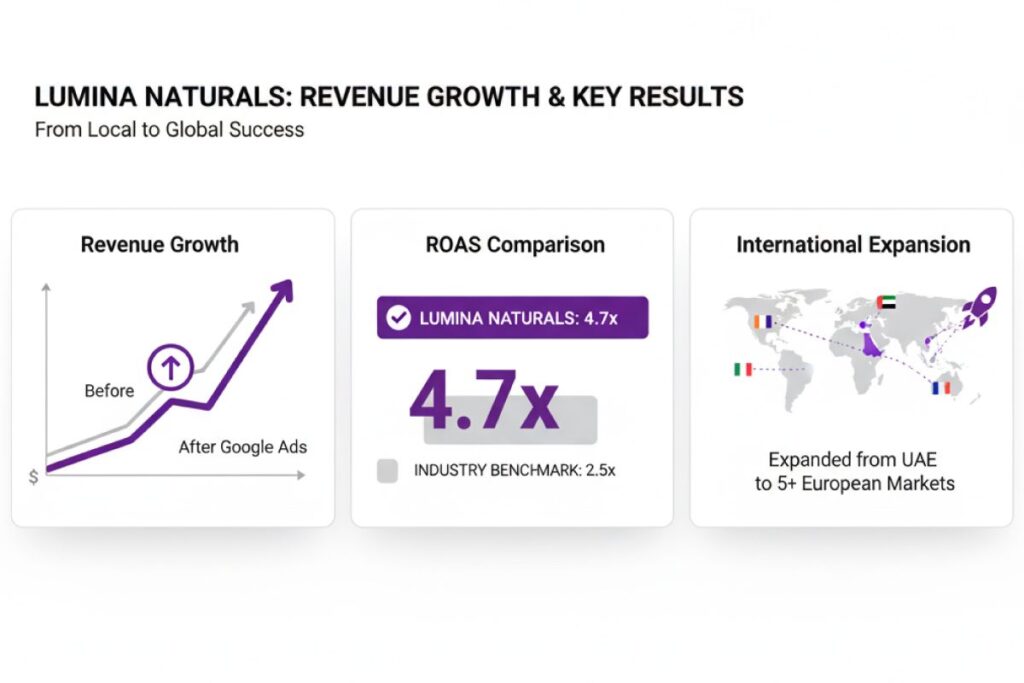
The Results
After 18 months, the results were clear:
- 643% increase in revenue (far above the 7.04% industry benchmark)
- 4.7 average ROAS (well beyond the 250% average ROI)
- 38% reduction in CAC
- Expansion into three new international markets
Lumina Naturals proved that when Google Ads campaigns are structured and executed properly, they don’t just generate clicks they become the engine of sustainable business growth.
Common Mistakes When Running Google Ads for E-commerce
Let me share some memorable mistakes that taught me valuable lessons (and cost clients money).
Set Up and Structure Disasters
The Zara Fiasco: Remember client number 156? Zara (not the fashion brand, but an artisanal jewelry maker from Bruges). She crammed 847 products into a single ad group, wondering why her ads weren’t showing.
The problem? Google’s algorithm couldn’t determine which products to prioritize. We restructured into 23 tightly themed ad groups, and performance improved 290% within a month.
Common Structure Mistakes:
- Mixing unrelated products in single campaigns
- Using overly broad keyword match types initially
- Ignoring the negative keyword strategy from day one
- Creating generic ad copy for diverse product lines
Budget and Bidding Blunders
The Impatient Entrepreneur Malik from Dubai ran an online spice business called “Saffron Stories.” On day three of his campaign launch, he panicked, seeing high costs per click, and slashed all bids by 70%.
Result? His ads disappeared from search results overnight. The lesson: initial data isn’t representative. Give campaigns 2-3 weeks minimum before major adjustments.
Budget Mistakes to Avoid:
- Starting with insufficient budgets for meaningful data
- Making bid changes before statistical significance
- Ignoring seasonal demand fluctuations
- Poor budget distribution across campaign types
Tracking and Measurement Mayhem
The Attribution Mystery Sophia’s luxury handbag boutique “Velvet & Gold,” showed profitable ROAS in Google Ads but claimed no actual profit increase. The culprit? Incomplete conversion tracking is missing 40% of mobile purchases.
Tracking Fixes:
- Implement cross-device conversion tracking
- Set up enhanced e-commerce for detailed insights
- Track micro-conversions, not just purchases
- Regular data validation and troubleshooting
Quick Story: Once spent three hours debugging why a client’s conversion tracking showed zero purchases on Tuesdays. Turns out, their developer accidentally coded the tracking to pause on Tuesdays for “testing purposes” and forgot to remove it. Always double-check your tracking logic!
Advanced Strategies for Running Successful E-commerce Google Ads
After managing 300+ accounts, I’ve found that these advanced strategies separate profitable campaigns from money-burning disasters. Let me explain briefly, while showing how I used them to triple the sales of my New York client Daniel’s gadget shop.
Dynamic Remarketing Mastery
- Segmentation I built for Daniel:
- Visitors who viewed gadget categories (e.g., headphones, smartwatches)
- Cart abandoners with high-ticket items
- Repeat buyers for upselling premium gadgets
- Price-sensitive shoppers targeted with coupon codes
- Visitors who viewed gadget categories (e.g., headphones, smartwatches)
Result: Abandoned-cart remarketing ads alone recovered 28% of lost revenue, while upsell campaigns doubled accessory sales.
Automation and AI Integration
- Smart Bidding Tactics Used:
- Target ROAS after 50+ conversions/month
- Maximize Conversions for new product launches
- Enhanced CPC for testing high-demand gadgets
- Target ROAS after 50+ conversions/month
- Performance Max Campaign Setup:
- 15+ headlines (“Affordable Tech for Everyday Life” → “Premium Gadgets, Fast Delivery in NY”)
- 5+ unique descriptions
- High-quality lifestyle images + demo videos
- 15+ headlines (“Affordable Tech for Everyday Life” → “Premium Gadgets, Fast Delivery in NY”)
- Result: Performance Max campaigns boosted gadget sales by 3x within 4 months.
Competitive Intelligence Tactics
- Auction Insights: I discovered two major NY competitors outspending Daniel.
- Conquest Campaign: We ethically targeted competitor keywords with stronger offers (e.g., “Faster Delivery,” “Free 2-Year Warranty”).
- Advanced Twist: Similar Audiences were used to capture competitor-like buyers without brand-bidding risks.
- Result: Daniel gained a 19% market share increase, stealing loyal customers from bigger brands.
E-commerce Google Ads Success Stories and Case Studies
Small Business Growth: $10K to $100K Monthly Revenue
Client Profile: Nora’s artisanal coffee roastery, “Mountain Peak Coffee” in the Swiss Alps, started with $8,000 monthly revenue and dreams of national expansion.
Initial Challenges:
- Limited brand awareness outside the local region
- High competition from established coffee brands
- Seasonal demand fluctuations
- Premium pricing positioning
Strategy Implementation: Month 1-2: Focused on Shopping campaigns for core products. Month 3-4: Expanded to Search campaigns targeting coffee enthusiast keywords. Months 5-8: Implemented remarketing and lookalike audiences. Month 9-12: Scaled successful campaigns and expanded geographic targeting
Results Timeline:
- Month 3: $18,000 revenue (125% increase)
- Month 6: $41,000 revenue (412% increase)
- Month 12: $97,000 revenue (1,112% increase)
- Final ROAS: 6.8:1 across all campaigns
Success Factors:
- Premium positioning with quality-focused messaging
- Seasonal campaign adjustments for holiday gift buying
- Customer lifetime value optimization
- Geographic expansion based on performance data
Seasonal Campaign Excellence: Holiday Shopping Success
Background: Worked with “Frost & Ember Candles” owner Elena to prepare for their first major holiday season advertising push.
90-Day Preparation Strategy: September: Historic performance analysis and goal setting, October: Campaign structure buildout and creative developmen,t November: Aggressive scaling and optimization
Campaign Structure:
- Black Friday: 48-hour flash sale campaigns
- Cyber Monday: Online exclusive product promotions
- Holiday Gifting: December gift-focused messaging
- Last-Minute: Express shipping promotions
Peak Performance Results:
- Black Friday: 847% revenue increase vs. typical Friday
- Cyber Monday: 1,200% traffic increase with 7.3 ROAS
- December average: 340% month-over-month revenue growth
- Post-holiday retention: 23% of new customers made repeat purchases
Lessons Learned:
- Start holiday preparation 90 days early
- Create urgency without appearing desperate
- Prepare inventory for demand surges
- Plan post-holiday retention campaigns
International Expansion Case Study
Challenge: “Nexus Electronics” owner Rahman wanted to expand from the UAE to European markets while maintaining profitability.
Market Research Phase:
- Analyzed keyword search volumes across target countries
- Studied local competitor strategies and pricing
- Evaluated shipping logistics and return policies
- Researched cultural preferences and buying behaviors
Localization Strategy:
- Germany: Engineering and quality-focused messaging
- France: Design and aesthetics emphasis
- UK: Value and convenience positioning
- Netherlands: Sustainability and innovation angles
Scaling Framework Results:
- Month 1: Germany launch – 4.2 ROAS
- Month 3: France expansion – 3.8 ROAS
- Month 6: UK and Netherlands – 4.5 average ROAS
- Month 12: Combined international revenue exceeded domestic sales
Key International Success Factors:
- Currency-specific campaigns and pricing
- Local language ad copy and landing pages
- Country-specific shipping and return policies
- Cultural adaptation of product positioning
Personal Learning: My biggest mistake was assuming European markets would respond similarly to UAE campaigns. Each market required unique messaging and positioning strategies.
Frequently Asked Questions
Conclusion
Running successful Google Ads for e-commerce isn’t about overnight miracles or secret shortcuts. It’s about systematic implementation, consistent optimization, and patient scaling of what works.