
The $2,400 Paper Mistake That Changed Everything
Last month, a design agency lost $2,400 because they picked the wrong paper. Their tri-fold brochures cracked along every fold. Half the batch went straight to the trash.
Hi, I’m Amin Ahmed. After helping 800+ businesses choose the perfect brochure paper across 5 countries, I’ve seen this costly mistake too many times. The truth? Your paper choice can make or break your entire marketing campaign.
With the global commercial printing market reaching $779.86 billion in 2024 and expected to grow at a 2.2% CAGR to reach $969.45 billion by 2034, competition for attention has never been tougher. Yet most businesses still treat paper selection as an afterthought.
Ready to stop wasting money on paper mistakes? Let’s dive in.
1. Why Your Paper Choice Makes or Breaks Success
Your paper directly impacts first impressions, brand trust, and customer engagement. Quality paper can boost response rates by 25-40%.
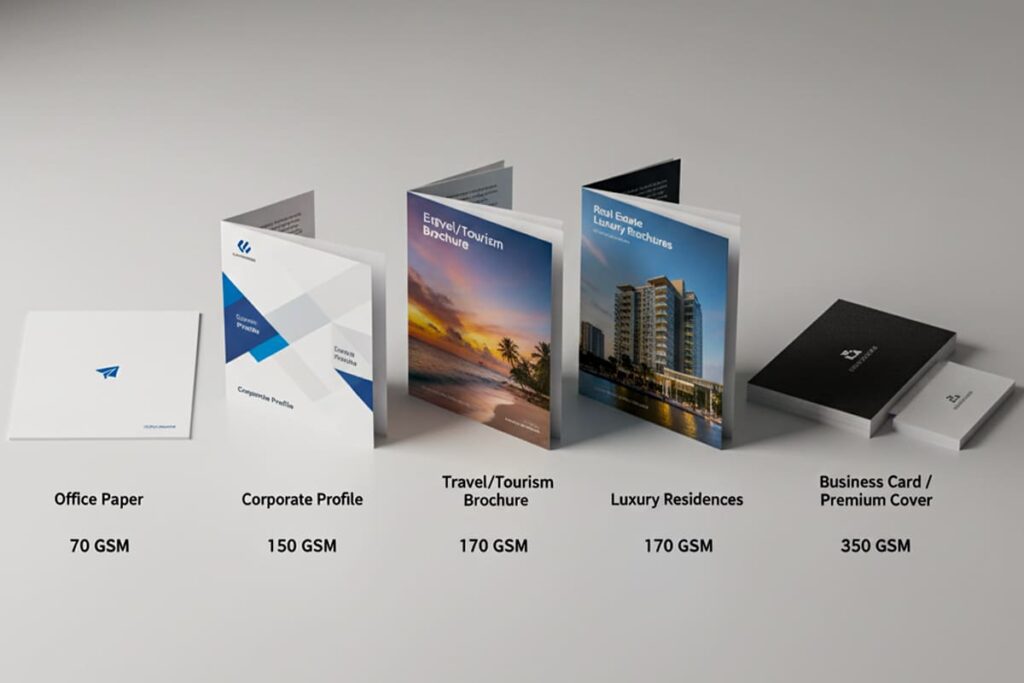
Two identical brochures. Same design, same message. One printed on cheap 70 GSM paper, the other on premium 170 GSM silk finish. Which one would you trust more?
Your customers make the same instant judgment. Here’s what my 7 years of testing revealed:
• Tactile memory works: People remember 65% more when they can touch quality materials
• Brand perception: According to Forbes, 68% of millennials bought an environmentally friendly product in the last year
• Durability matters: Quality paper survives 3x longer in offices and homes
• ROI boost: Investing 20-30% more in better paper often increases response rates by 15-25%
Real Example: When Zephyr Tech Solutions (a software company in Rajshahi) switched from basic 80 GSM to 150 GSM silk finish, their brochure retention jumped 60%. Clients stopped throwing them away.
2. Understanding GSM and Paper Weight Systems
The Paper Weight Crisis
Three years ago, Luminous Creative Studio called me in panic. They’d printed 5,000 brochures for a major client. The paper was too thick to fold. Result? Cracked folds on every piece and an irate client.
This expensive lesson taught me to always explain paper basics first.
Paper Weight Measurements Made Simple
GSM (Grams per Square Meter): The international standard. Higher number = thicker paper. Pounds (lb): US measurement based on 500 sheets. Also, higher = thicker.
| GSM Range | Pound Equivalent | What It Feels Like | Best Use |
| 70-100 GSM | 19-27 lb text | Magazine paper | Bulk mailers |
| 120-170 GSM | 32-45 lb text | Quality standard | Business brochures |
| 200-250 GSM | 54-67 lb text | Business card thickness | Premium materials |
| 280-350 GSM | 75-95 lb cover | Almost cardboard | Luxury application |
The Feel Test
I always tell clients, “Close your eyes and touch these samples.” The response is instant:
• Under 120 GSM: “Feels cheap”
• 150-200 GSM: “Professional and trustworthy”
• Over 250 GSM: “Expensive and luxurious”
Pro Tip: For 80% of business brochures, 150 GSM hits the sweet spot of quality and affordability.
3. Complete Paper Weight Selection Guide
Step 3A: Lightweight Options (70-100 GSM)
When to Use 70 GSM: Remember the community health campaign for Nirala Healthcare? With 10,000 pieces and an $800 budget, 70 GSM was perfect for bulk distribution.
Best for:
• Mass mailers and flyers
• Event programs (single use)
• Budget campaigns under $0.10 per piece
Avoid for:
• Professional business meetings
• Luxury brand materials
• Long-term reference documents
Step 3B: Professional Standard (120-170 GSM)
The 150 GSM Sweet Spot: This is my go-to recommendation for 70% of clients. From law firms in Sylhet to tech companies in Helsinki, this weight delivers professional quality without breaking budgets.
Perfect for:
• Company brochures and profiles
• Product catalogs
• Real estate marketing
• Professional services
Cost Analysis:
• 150 GSM costs about 40% more than 70 GSM
• But increases perceived value by 200%
• Sweet spot for most business applications
Step 3C: Premium Options (200-350 GSM)
Luxury Applications: When Platinum Residences needed brochures matching their $2M+ condos, we chose 250 GSM with a soft-touch finish. Result? 85% of prospects kept them for over 6 months.
Use for:
• High-end real estate
• Luxury goods and services
• Award ceremonies
• Premium brand positioning
4. Paper Finish Guide: Making the Right Choice
The Arctic Adventures Disaster
Here’s a mistake that cost me a client relationship. Arctic Adventures insisted on a glossy finish for their hiking guide brochures. The result? Unreadable text under outdoor sunlight. We had to reprint everything in matte.
Quick Decision Framework:
| Content Type | Best Finish | Why | Industry Examples |
| Photo-heavy | Glossy | Maximum color impact | Travel, food, products |
| Text-heavy | Matte | Easy reading, no glare | Legal, corporate, medical |
| Mixed content | Silk | Perfect balance | Technology, real estate |
| Eco-brands | Uncoated | Natural, sustainable feel | Non-profits, organics |
Step 4A: Glossy Finish
When Glossy Wins:
• Photography showcases (travel, food, products)
• Art galleries and exhibitions
• Fashion and beauty brochures
• Children’s educational materials
Technical Benefits:
• 40% better color vibrancy
• Sharp image reproduction
• Professional photography enhancement
Major Drawbacks:
• Text becomes hard to read under lights
• Shows fingerprints easily
• Glare problems in bright environments
Step 4B: Matte Finish
The Corporate Favorite: My business clients love matte. When designing for Sterling Financial, the matte 170 GSM created the perfect “trustworthy banker” impression.
Why Matte Works:
• Zero glare for comfortable reading
• Sophisticated, premium look
• Perfect for text-heavy designs
• Professional credibility boost
Step 4C: Silk/Satin Finish
The Balanced Choice: Silk finish has become increasingly popular. Quantum Tech chose it for software brochures, achieving modern appeal without glossy problems.
Silk Advantages:
• Subtle shine without reflection issues
• Good readability with visual enhancement
• Modern, contemporary feel
• Works across multiple industries
5. Industry-Specific Paper Matching
Success Stories by Industry:
Tourism & Real Estate:
• Paper: 170-250 GSM, Glossy/Silk
• Result: Wanderlust Travel saw 45% more bookings after upgrading paper
Professional Services:
• Paper: 150-200 GSM, Matte/Silk
• Result: Corporate clients report increased credibility
Budget Events:
• Paper: 100-150 GSM, Standard finishes
• Result: Cost-effective without looking cheap
Luxury Brands:
• Paper: 250+ GSM, Specialty finishes
• Result: Royal Heritage Hotels guests asked for extra brochures as souvenirs
6. Eco-Friendly Options That Actually Work
Use of FSC-certified paper has exploded over the past few years, nearly becoming an industry standard. Modern eco-friendly papers match virgin paper quality while supporting sustainability.
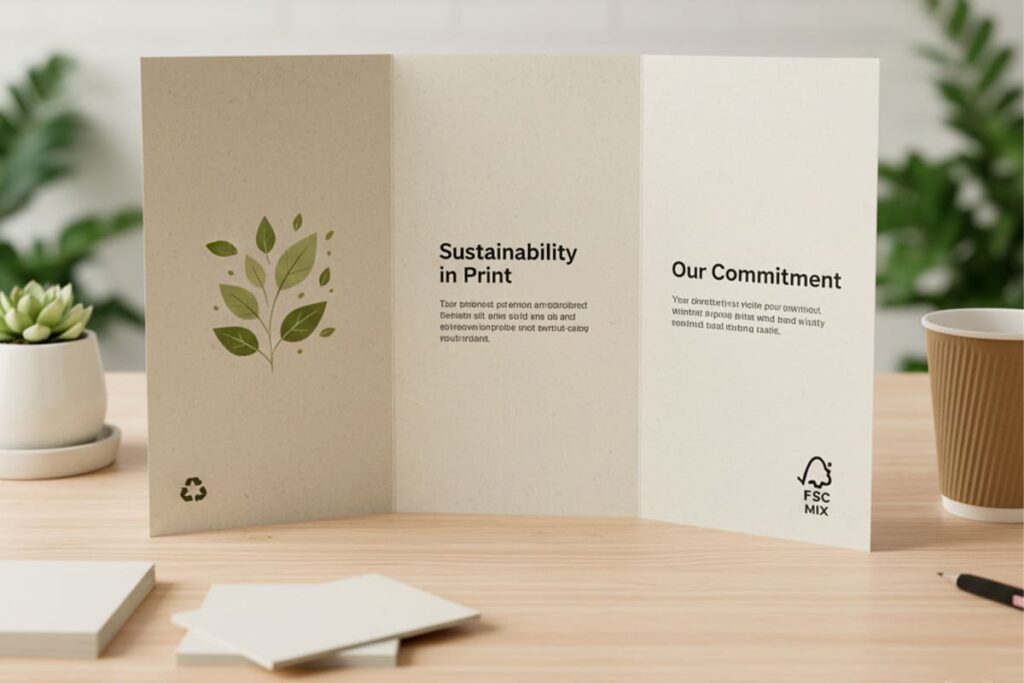
FSC-Certified Papers
Real Example: EcoVision Architects needed brochures aligning with their LEED certification goals. FSC-certified 150 GSM matte worked perfectly and supported their environmental messaging.
Benefits:
• FSC system can help secure a long-term source of paper while enabling the paper and printing sectors to demonstrate their commitment to responsible forestry
• Brand credibility with eco-conscious customers
• Often similar pricing to non-certified options
• Compliance with green building requirements
Market Trends:
As sustainability stands increasingly at the core of technological innovation in 2025, FSC-certified papers have become mainstream. The sustainable printing market is witnessing exponential growth, with business cards segment projected to grow at a 9.4% CAGR through 2030 as companies prioritize eco-friendly image projection.
7. Cost Optimization Strategies
The Budget Truth: The cheapest paper is rarely the most economical choice.
Smart Budget Framework:
Economy Range ($0.08-$0.15 per piece):
• 80-120 GSM, standard finishes
• Perfect for mass distribution
Professional Range ($0.15-$0.30 per piece):
• 150-170 GSM, matte or silk finishes
• 80% of my clients choose this range
Premium Range ($0.30-$0.60 per piece):
• 200-250 GSM, specialty finishes
• ROI justified by increased response rates
Volume Discount Strategy:
With lithographic printing holding 40.9% of the commercial printing market in 2024 due to cost-effectiveness in high volume runs, and lithography dominating with 44.7% revenue share in the US market, volume discounts become crucial:
• 1,000-5,000 pieces: 10-15% discount
• 5,000-10,000 pieces: 15-25% discount
• 10,000+ pieces: Custom negotiation possible
With lithographic printing holding 40.9% of the commercial printing market in 2024 due to cost-effectiveness in high volume runs, and lithography dominating with 44.7% revenue share in the US market, volume discounts become crucial:
• 1,000-5,000 pieces: 10-15% discount
• 5,000-10,000 pieces: 15-25% discount
• 10,000+ pieces: Custom negotiation possible
9. Paper Selection Decision Tree
Interactive Quick Reference Guide:
Decision Guide (Final Choice)
Folding Requirements
| Project Type | Recommend Paper | Expected Cost | Key Benefits | Learn More |
| Corporate Brochures | 150 GSM Matte | $0.20-$0.25 each | Professional credibility | FSC Options |
| Visual Portfolios | 200 GSM Glossy | $0.30-$0.40 each | Maximum color impact | Sustainable Trends |
| Mass Distribution | 120 GSM Standard | $0.08-$0.15 each | Cost-effective reach | Market Analysis |
| Luxury Branding | 250+ GSM Specialty | $0.50+ each | Premium positioning | Growth Projections |
10. Common Mistakes to Avoid
Top 5 Costly Errors:
- Weight-to-Fold Mismatch: Don’t choose 250 GSM for multi-panel brochures
- Brand Misalignment: Luxury brands on cheap paper send conflicting messages
- Usage Ignorance: Trade show brochures need durability; office handouts don’t
- Finish Selection Errors: Glossy text-heavy brochures create reading problems
- Extreme Budget Choices: Neither cheapest nor most expensive is always right
Conclusion
Start with your brand message. Consider your audience. Factor in your budget. Then choose a paper supporting all three.
Remember Zephyr Tech’s 60% retention increase? Or Platinum Residences’ 6-month staying power? Quality paper choice made the difference.
Frequently Asked Questions
150 GSM (100 lb text) offers a perfect balance of professional feel and easy folding.
Choose glossy for image-heavy designs. Pick matte for text-heavy, professional applications.
Premium paper adds 20-40% to costs but can increase response rates by 15-25%.