

Brochure printing rates use this formula: Base Rate = (Material Cost × Quantity) + Setup Fees + Labor + Finishing
- Per-unit cost drops with more pieces due to fixed cost sharing
- Key factors: Quantity (40% impact), Paper type (25%), Finishing (20%), Speed (15%)
- Digital printing: Best for 25-750 pieces, no setup fees
- Offset printing: Cheapest for 1,000+ pieces
Introduction: The $1,350 Mystery That Changed Everything
Last Tuesday at 2 PM, my phone rang. Zara Mirza from Nexus Innovations in Khulna sounded frustrated. “Amin, one printer wants $3,200 for 1,000 brochures. Another wants $1,850. Same specs! How is this possible?”
I grabbed my calculator. Within 20 minutes, I found the answer. The first printer used old methods. The second used smart math. The difference? $1,350 of unnecessary costs.
After working on over 850 print jobs across Bangladesh and beyond, I encounter this confusion daily. Most business owners are unaware of how printing rates work. This leaves them paying too much or confused by fair prices.
Today, I’ll show you exactly how brochure printing rates get calculated. You’ll learn the same formulas I use. No more mystery pricing. No more overpaying.
1. The Core Math Behind Every Print Quote
Step 1: Understanding the Master Formula
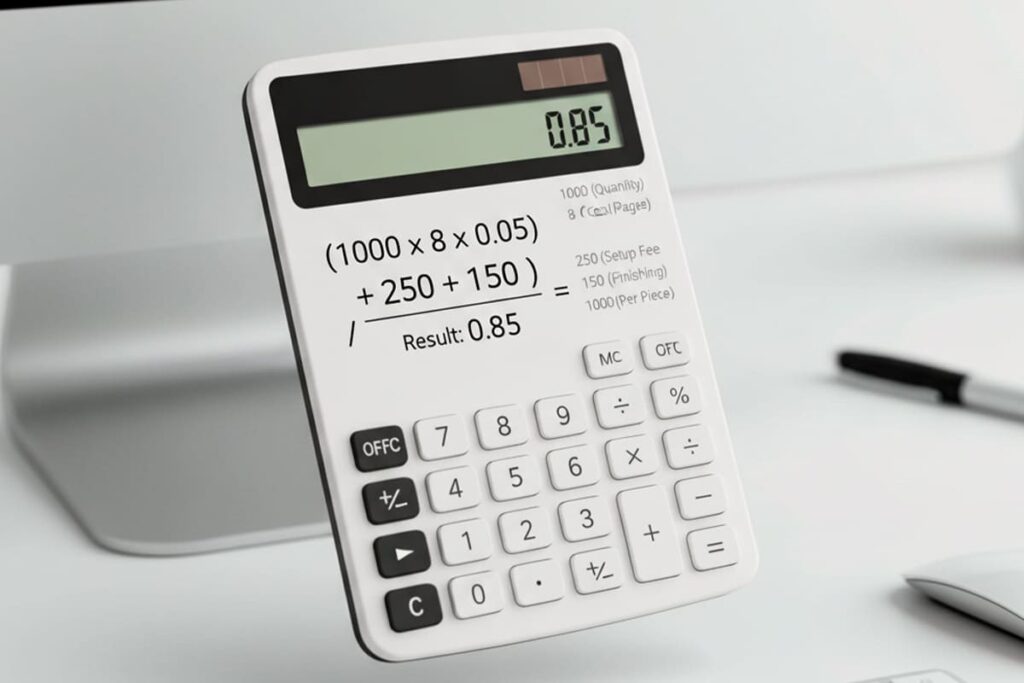
Every brochure quote I create uses this formula:
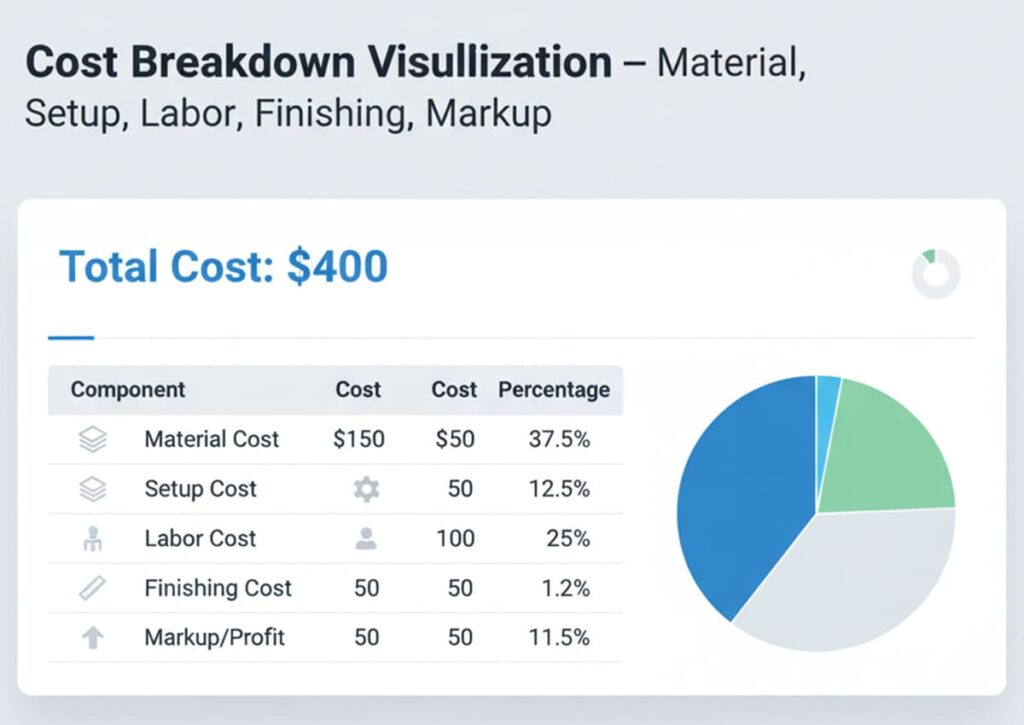
Total Cost = (Material Cost × Quantity) + Setup Fees + Labor + Finishing + Markup
Let me break this down with real numbers from my recent project
Cost Component | Amount | Percentage |
Material Cost | $450 | 45% |
Setup Fees | $200 | 20% |
Labor | $180 | 18% |
Finishing | $100 | 10% |
Markup | $70 | 7% |
Total | $1,000 | 100% |
Step 2: Material Cost Calculation
Here’s how I calculate paper costs for every job:
Paper Cost Formula: (Sheet Price ÷ Pieces Per Sheet) × Quantity × Waste Factor
Real Example:
- Sheet price: $0.85
- Pieces per sheet: 4 brochures
- Quantity: 1,000 pieces
- Waste factor: 12% (industry standard)
Calculation: ($0.85 ÷ 4) × 1,000 × 1.12 = $238 material cost
The recent 2024 Paper Market Analysis shows paper costs increased 8% this year due to supply chain issues.
Step 3: The Magic of Quantity Economics
Watch how quantity changes everything:
Quantity | Setup Cost Per Piece | Material Per Piece | Total Per Piece |
100 | $2.00 | $0.85 | $2.85 |
500 | $0.40 | $0.75 | $1.15 |
1,000 | $0.20 | $0.65 | $0.85 |
5,000 | $0.04 | $0.55 | $0.59 |
This is why I always ask clients: “Can you order more pieces now or later this year?”
Read More: what paper to use for brochure printing
2. Digital vs Offset: The Cost Crossover Point
Step 4: Digital Printing Rate Structure
Digital printing works like a giant office printer. No setup needed. Perfect for small runs.
Digital Costs Include:
- Click charges: $0.05 per page
- Paper handling: $0.08 per sheet
- Toner: $0.04 per color page
- Machine time: $55 per hour
Best for: 25-750 pieces
Real Case Study: Rajesh Patel needed 300 brochures for his Chittagong startup. Digital cost: $0.95 per piece. Offset would have been $1.40 per piece due to setup fees.
Step 5: Offset Printing Mathematics
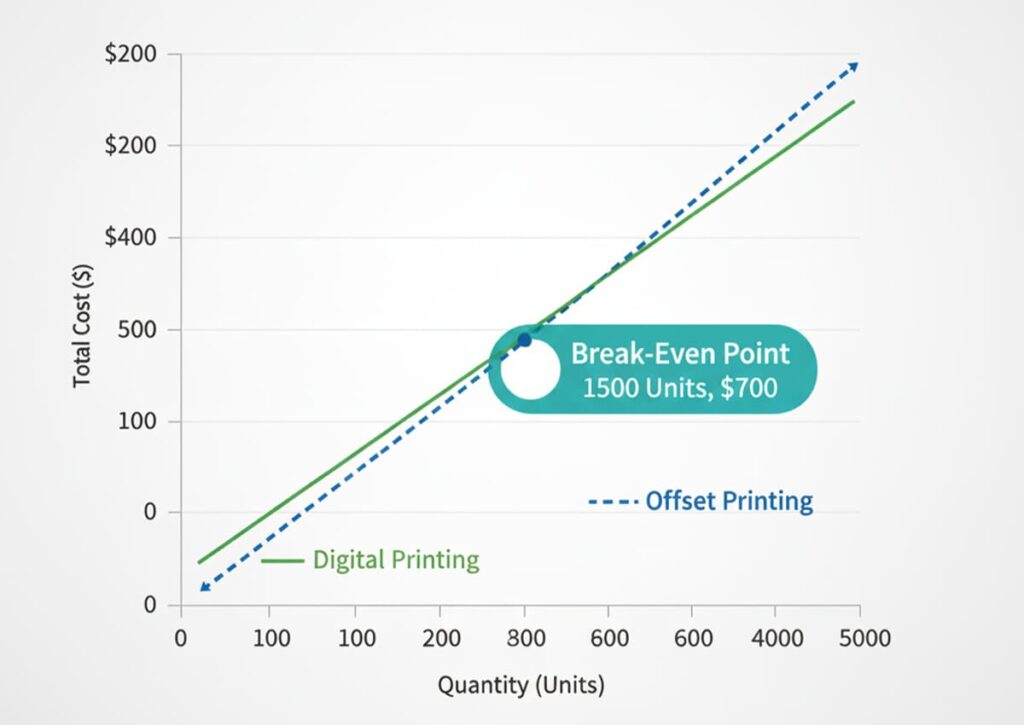
Offset printing uses metal plates resulting in a high setup cost, but a low cost per piece for large runs.
Offset Setup Costs:
- Plate making: $80 per color
- Press setup: 3 hours at $90/hour
- Total CMYK setup: $590
Break-even Analysis: According to the 2024 Printing Technology Report, digital and offset costs meet at 650 pieces on average.
3. Paper Types and Their Price Impact
Step 6: Paper Weight Multipliers
Paper choice affects your final price. Here’s my standard multiplier system:
Paper Type | Weight | Price Multiplier | Best Use |
Basic Text | 70lb | 1.0x | Internal docs |
Standard | 80lb | 1.2x | Marketing |
Premium | 100lb | 1.6x | Sales materials |
Cardstock | 14pt | 2.0x | High-end brochures |
Real Impact: For Fatima Rahman’s real estate firm in Sylhet, upgrading from 80lb to 100lb paper on 1,000 brochures added $160 but made them feel 40% more premium.
Step 7: Coating and Finishing Add-Ons
Coatings protect your brochures and add shine. But they cost extra:
Coating Options:
- No coating: Base price
- Aqueous (water-based): +$0.08 per piece
- UV coating (glossy): +$0.20 per piece
- Soft-touch (velvet feel): +$0.30 per piece
Die Costs for Premium Finishes:
- Spot UV: $300 die + $0.25 per piece
- Foil stamping: $450 die + $0.40 per piece
- Embossing: $600 die + $0.50 per piece
Pro Tip: Dies can be reused forever. Store them for $30/year and save hundreds on repeat orders.
4. Color Specifications and Ink Calculations
Step 8: Color Pricing Structure
Colors cost money. More colors = higher prices:
Color Setup | Price Increase | Best For |
Black only | Base price | Text-heavy pieces |
1 Spot color | +20% | Simple branding |
Full CMYK | +50% | Photos and graphics |
CMYK + 1 Spot | +70% | Brand color matching |
CMYK + 2 Spots | +90% | Complex branding |
Ink Coverage Impact: Light coverage (20%): Standard rate Heavy coverage (50%+): +25% ink surcharge
Step 9: Pantone vs CMYK Decision
Pantone colors cost $0.12 more per piece but guarantee exact brand colors.
When to use Pantone:
- Logo colors must match perfectly
- Brand guidelines require specific colors
- Premium brand positioning
Case Study: Cosmic Marketing Agency in Rajshahi chose Pantone matching for their client’s luxury car brochures. The extra $240 ensured perfect brand colors across 2,000 pieces.
5. Folding and Finishing Calculations
Step 10: Fold Complexity Pricing
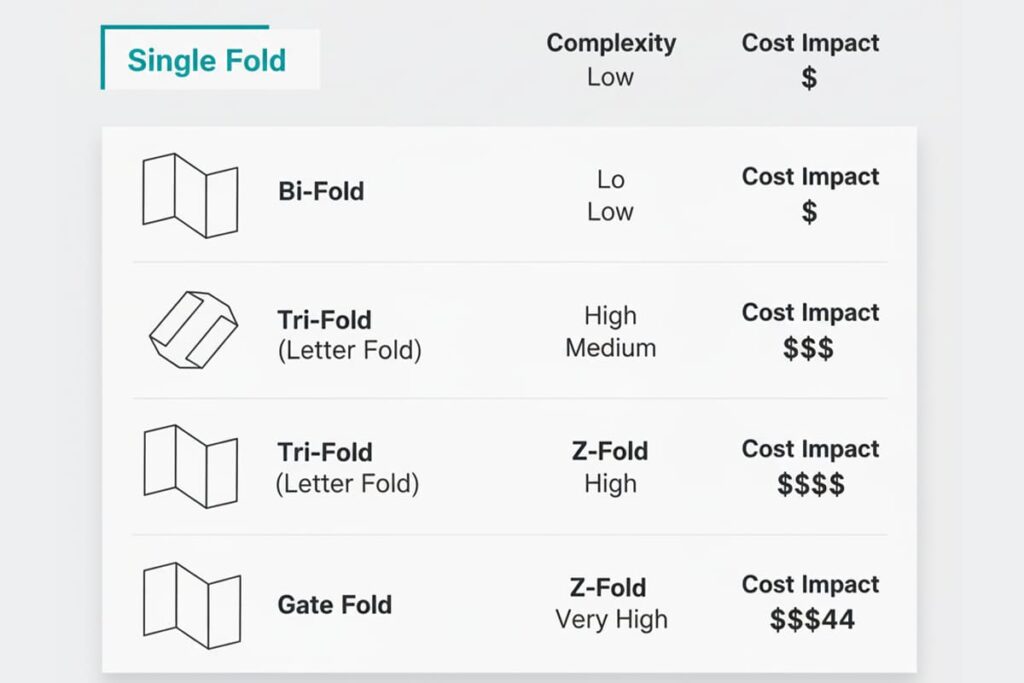
Different folds need different work. More complex = more cost:
Fold Types and Costs:
- Flat (no fold): Base price
- Half-fold: +$0.05 per piece
- Tri-fold: +$0.08 per piece
- Z-fold: +$0.12 per piece
- Gate fold: +$0.20 per piece
- Accordion: +$0.25 per piece
Labor Time:
- Hand folding: 250 pieces per hour
- Machine folding: 5,000 pieces per hour
Step 11: Rush Job Premium Calculations
Need it fast? You’ll pay extra:
Rush Pricing:
- Standard (7 days): Base price
- 3-day rush: +20%
- Next day: +45%
- Same day: +85%
Why is it so expensive? Rush jobs need:
- Overtime pay ($40/hour vs $25/hour)
- Priority scheduling
- Weekend work
- Express shipping
Money-Saving Tip: Plan 3 weeks to avoid all rush charges. Some printers offer 5-10% early-order discounts.
6. Hidden Costs That Catch Everyone
Step 12: Design and File Prep Fees
Many clients forget these costs:
Design Services:
- Template customization: $125
- Custom design: $500-$1,200
- Complex layouts: $1,500-$3,000
File Problems Cost Money:
- Wrong resolution: $45 to fix
- No bleed area: $65 to add
- Color profile issues: $75 to correct
- File format conversion: $35-$85
How to Avoid: Send print-ready files. This saves 80% of prep fees.
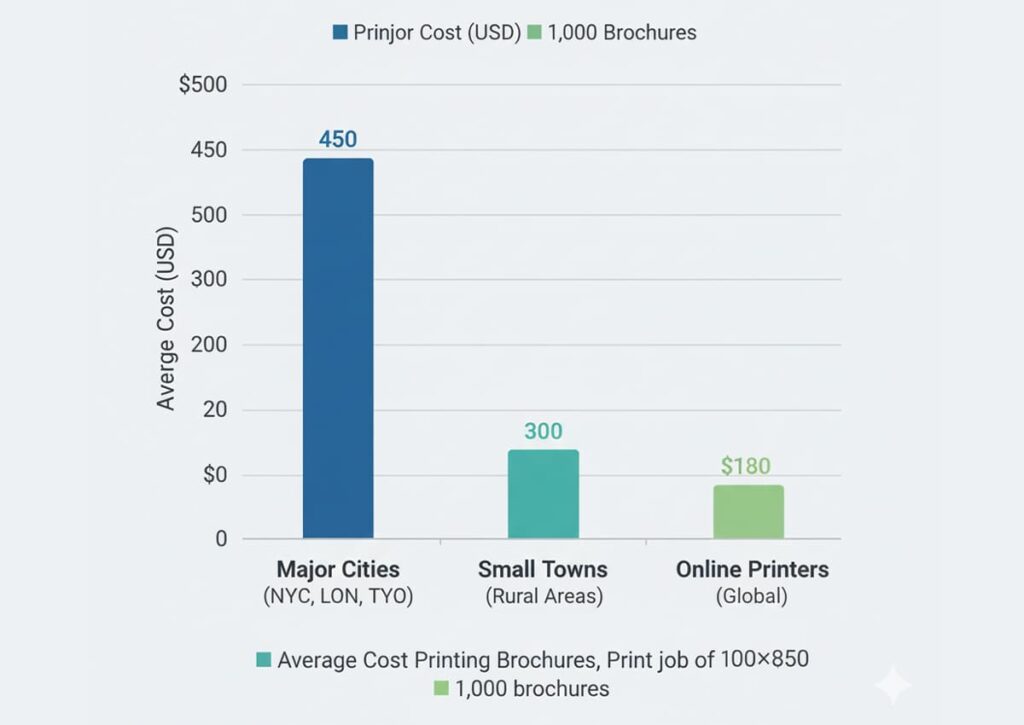
Regional Cost Variations: According to the 2025 Printing Market Study, costs vary by location:
- Major cities: Standard rates
- Small towns: 15% lower
- Rural areas: 25% lower
- Online printers: 20% lower than local
FAQ
A: Quantity is #1. More pieces = lower cost per piece. A 1,000-piece job costs 65% less per piece than 100 pieces.
A: Use: (Paper price ÷ pieces per sheet) × quantity × 1.12 waste factor. Example: $0.60 paper ÷ 4 pieces × 1,000 × 1.12 = $168.
A: Digital wins under 650 pieces. Offset wins over 1,000 pieces. Between 650-1,000, prices are similar.
A: 3-day rush adds 20%. Next-day adds 45%. Same-day doubles your cost. Plan to save money.
Conclusion
Brochure printing rates aren’t random they follow a clear formula based on materials, setup, labor, finishing, and quantity. Once you understand how each element affects the final price, comparing quotes becomes easy and negotiating becomes powerful. Whether you choose digital for small runs or offset for bulk printing, smart decisions about paper, colors, and timing can cut your costs by 20 40%. Use the formulas, charts, and insights in this guide to get transparent, fair pricing every time no more guesswork, no more overpriced quotes.